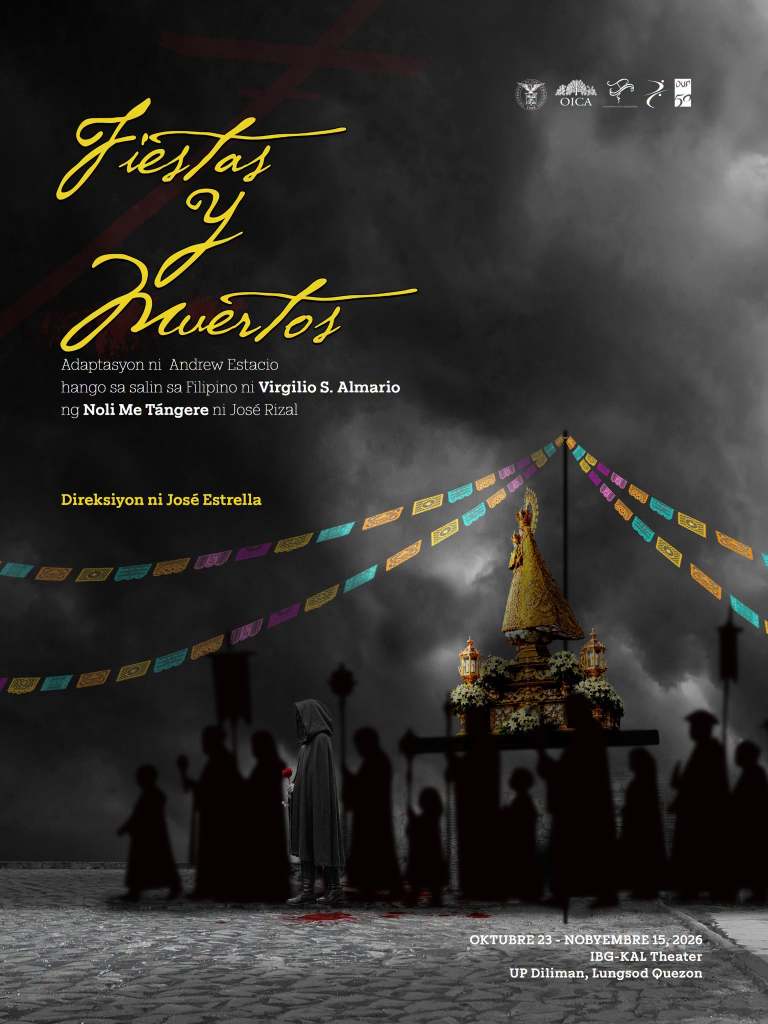
Fiestas y Muertos serves as the core dramaturgical concept for the reimagination of Dulaang UP’s Noli Me Tángere (Noli). It divides the narrative into two stark visual and emotional realms: the chaotic, enforced joy of public festivities (fiestas) and the silent, haunting truth of systemic decline and death (muertos). This dichotomy reflects the societal ailment of Spanish-colonial San Diego, where opulent religious celebrations are exploited by the ruling class to conceal extreme poverty, corruption, and psychological harm. By viewing José Rizal’s novel through this framework, the production shifts from a traditional period piece to a lively, ritualistic cycle of life, death, and societal spectacle.
Fiestas y Muertos depicts the chapters of Rizal’s Noli as lively scenes that explore festivities and death. During festivals, Filipino communities come alive with vivid colors, loud brass music, and stiff, mechanical movements, highlighting the performative nature of their piety. These celebrations turn the community into a lively theater of collective gratitude and devotion, blending Catholic rituals with communal spectacle. Townspeople transform public spaces into stages for spiritual exchanges, fulfilling panata (vows) through actions like marching in detailed street processions or carrying heavy patron statues. This public display of faith is closely linked to bayanihan, where families go to great lengths, even going into debt to host luxurious banquets for strangers, seeing extreme hospitality as a religious duty to attract future blessings. In the end, the fiesta is a grand show of abundance and piety, dissolving the strict hierarchy of church liturgy into a vibrant, energetic celebration of community and survival.
In the community, any death also involves a focus on performative expressions of piety. The response to a death unfolds as a coordinated act of collective mourning, where religious observances and pre-colonial taboos are publicly enacted to reinforce social bonds and facilitate the soul’s transition. This performative piety is evident during the lamay (wake), where the community observes a mandatory presence, keeping the body company and engaging in gambling or storytelling to sustain an all-night vigil. Spiritual effort is expressed through the organized rituals of the pasiyam (nine-day novena), led by a community elder and supported by the family’s hospitality. Additionally, piety is strictly observed through negative actions like not sweeping the floor or practicing pagpag (stopping at a neutral spot before returning home), which physically and behaviorally demonstrate respect for the dead and protect the living from restless spirits.
In the novel, José Rizal skillfully reveals how the performative aspects of fiestas and death are exploited by the Spanish colonial ruling class to control and manipulate San Diego’s people. During the town fiesta, exaggerated religious acts are portrayed as empty, state-approved shows; characters like Capitan Tiago go bankrupt financing lavish banquets and processions to gain social status and spiritual favor. Meanwhile, the oppressive Franciscan friars, such as Padre Damaso, demand superficial piety from the pulpit to affirm their dominance. Similarly, death rituals are stripped of genuine spiritual comfort and instead become tools of institutional terror and extortion. This is seen when the church denies a Christian burial to Don Rafael, Ibarra’s father, and through Sisa’s family, where church bells toll as instruments of physical punishment and psychological terror for her young sons. By incorporating these cultural practices into the story, Rizal shows how traditional instincts of bayanihan and grief are distorted into means of colonial control, hiding societal decay behind a facade of sacred celebration.
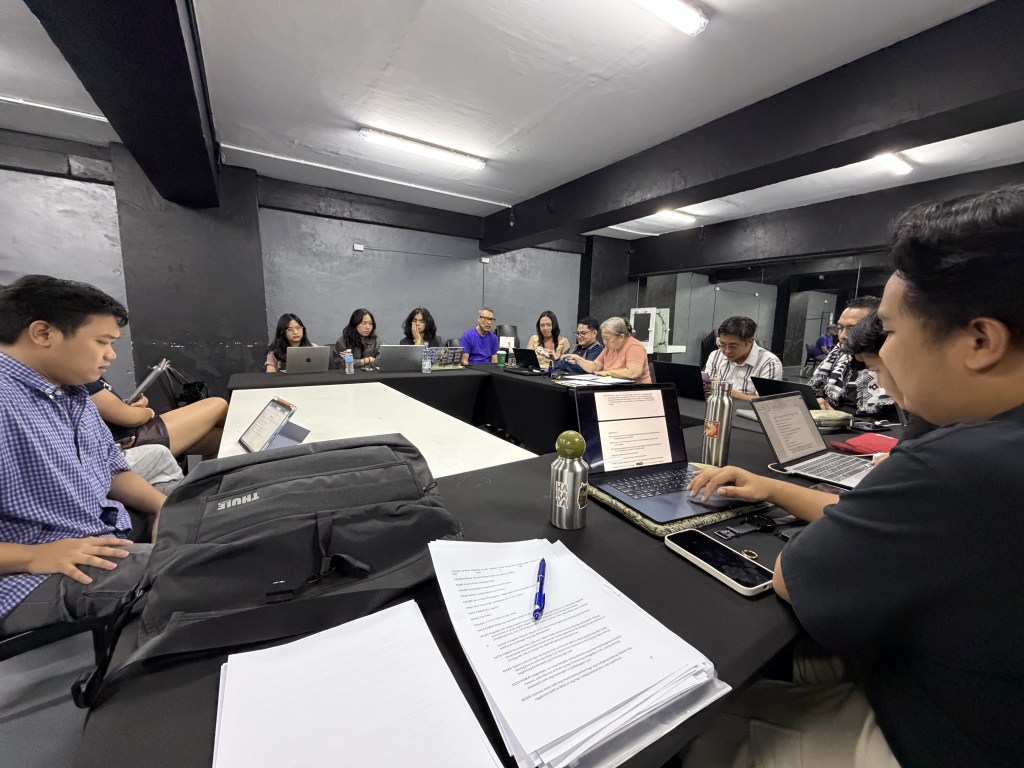
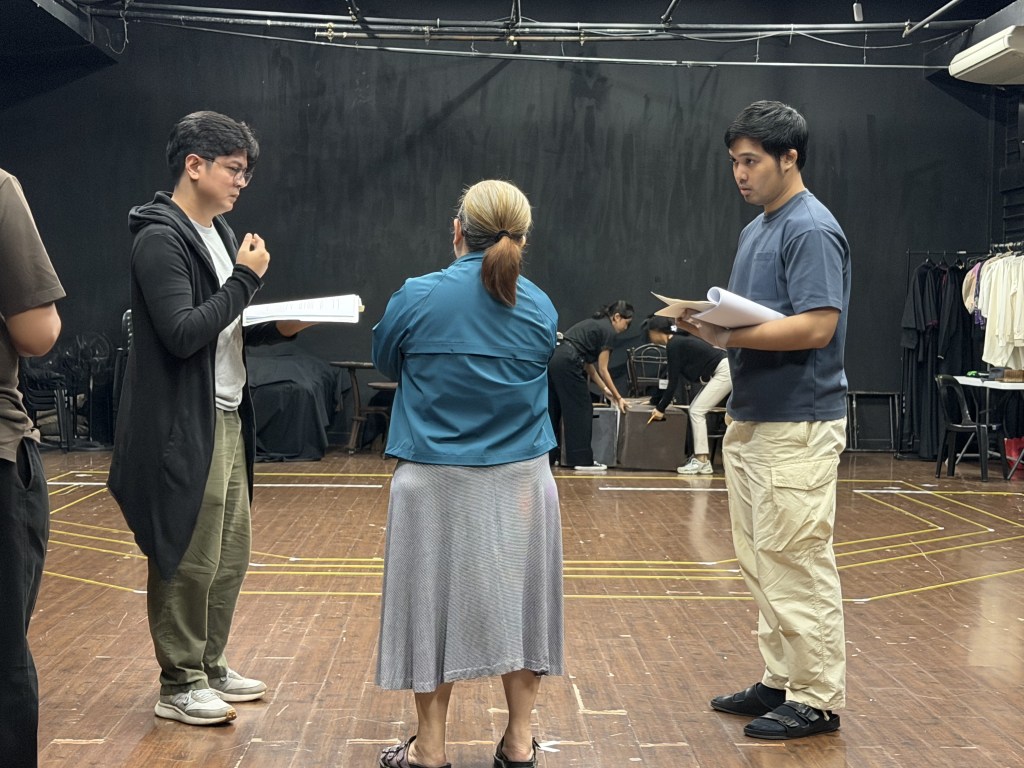
held at the Dressing Room 7 of the UP Theater, held on 1 September 2026.
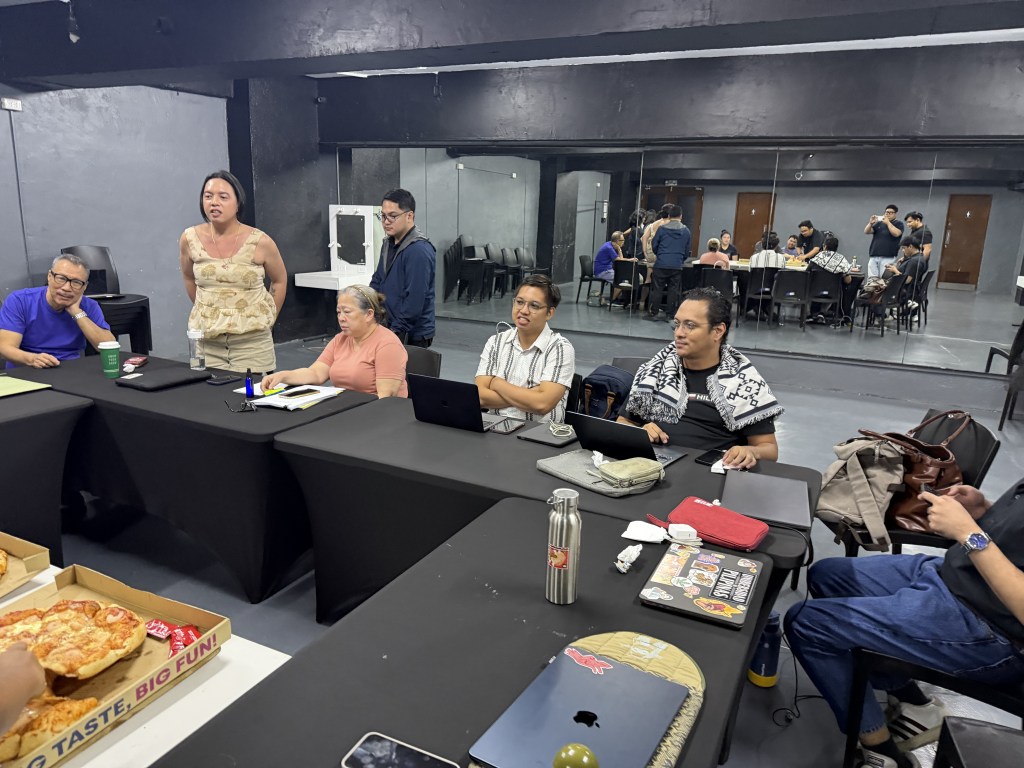
held at the Dressing Room 7 of the UP Theater, held on 1 September 2026.
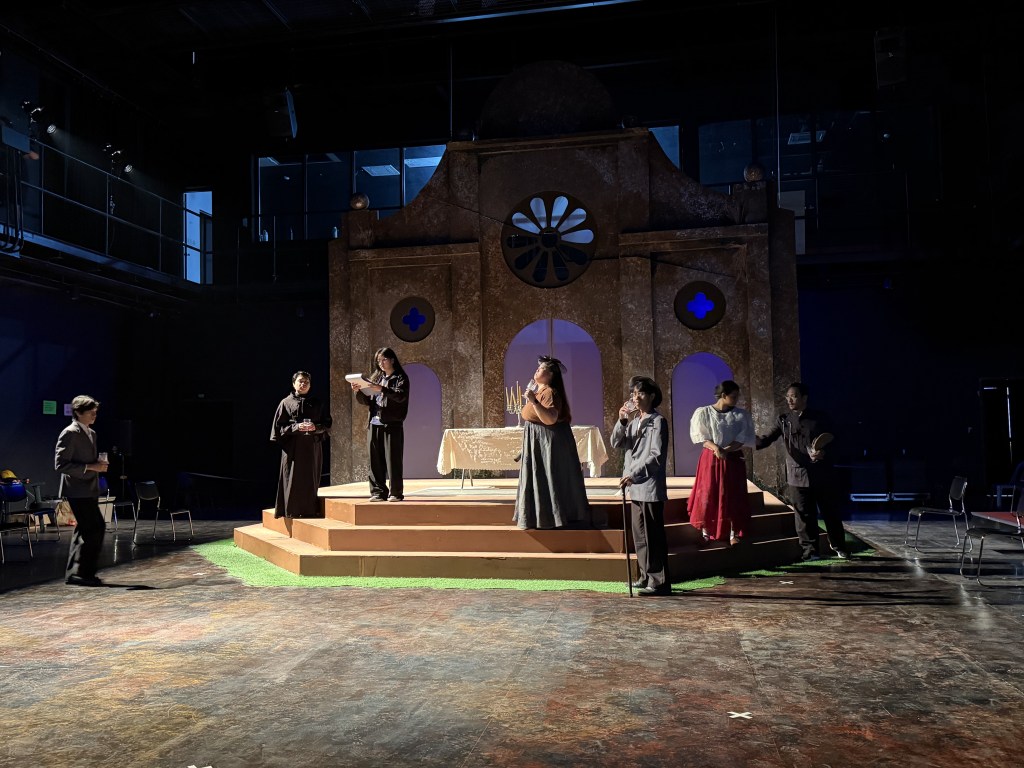
The Fiestas y Muertos framework transforms José Rizal’s characters from mere historical figures into enduring mythical symbols of survival and sacrifice caught within a collapsing colonial system. Crisostomo Ibarra, for instance, embodies the naive optimism of the fiesta. Having just returned from Europe, he approaches with an upbeat outlook, convinced that the rot in San Diego can be fixed through Western progress, education, and diplomacy. His effort to fund and build a modern school reflects the lavish, performative nature of a fiesta—an attempt to mask society’s deep sickness with a veneer of enlightenment. Ibarra severely underestimates the environment; he attempts to nurture a future seed in soil riddled with death and colonial corruption. His tragedy stems from this misjudgment. The system is unchangeable and beyond reform, and his efforts to appear civil and reform-minded within a barbaric power structure ultimately lead to his downfall, tearing away his festive facade to reveal the harsh truth.
In stark contrast, Sisa, Elias, and Pilosopong Tasio are like the living dead, constantly existing in the realm of the muertos. They have been completely deprived of illusions, bearing the immediate physical and psychological toll of the colony’s brutality. Sisa symbolizes psychological martyrdom; the colonial system shatters her mind, turning her into a wandering ghost who haunts the outskirts of town celebrations—an visceral reminder of the human collateral sacrificed to uphold the status quo. Elias embodies the physical embodiment of the muertos, a fugitive hunted by the state, with his entire lineage wiped out by injustice. He moves stealthily through swamps and forests like a specter, fully aware that his life is already sacrificed for the cause of liberation. Pilosopong Tasio symbolizes intellectual death; dismissed as mad by a community blinded by performative piety, he records in hieroglyphics for future generations, choosing to bury his wisdom now so it can survive the cultural graveyard of his era.
The stark contrast between Ibarra’s joyful facade and the harsh reality faced by the marginalized fuels the tragic development of this reimagined Noli staging. On stage, this manifests as a structural clash: each moment of celebration is pulled back by the ghosts of San Diego. Witnessing Ibarra’s optimistic hopes violently shattered by Sisa’s madness and Elias’s sacrifice, Fiestas y Muertos prompts the audience to confront a deep philosophical question: Which corrupt structures, institutions, and illusions must be abolished to enable real social liberation?
Sir Anril P. Tiatco and Jem R. Javier, Dramaturgs
The dramaturgical sessions for Fiestas y Muertos were partially subsidized by the research project Contemporary Theatre Makers: Politics and Engagement, Community and Innovation (2626216 ORG) funded by the University of the Philippines Diliman Office of the Vice Chancellor for Research and Development through the Outright Research Grant.

