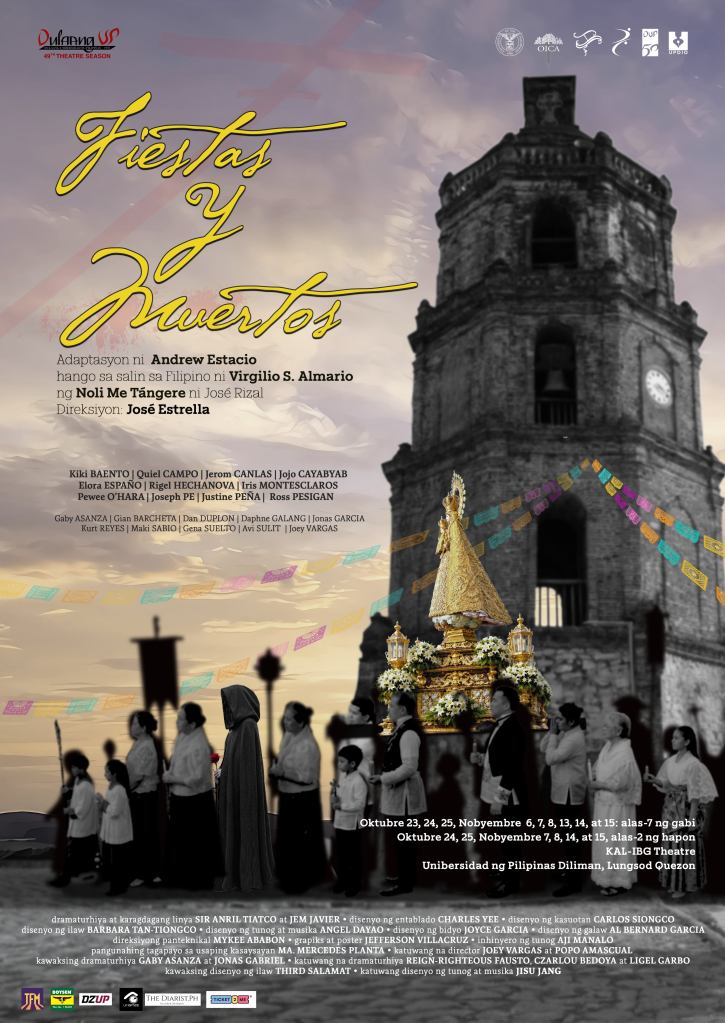
José Rizal’s foundational novel Noli Me Tángere undergoes a profound theatrical transformation in Fiestas y Muertos. Beautifully translated into Filipino by National Artist Virgilio S. Almario, the novel offers a sweeping, layered critique of Spanish colonial rule in the Philippines, revealing society’s structural rot through a broad cast of characters. Condensed and reimagined for the stage under a title that starkly contrasts celebration with mortality, the story takes on a new form. This essay explores how the sprawling epic of colonial suffering becomes a focused, rhythmic, and hauntingly visceral theatrical experience.
At the heart of this transformation is the thematic narrowing reflected in the title Fiestas y Muertos. We agreed on this title for our final adaptation during a trip to the Cultural Center of the Philippines—serendipitously, in a traffic jam along Roxas Boulevard, right in front of Rizal Park. At the time, some members of the dramaturgical team and director José Estrella were discussing the play’s conceptual life and the need to adapt it for the present.
In our discussion with our playwright, Andrew Estacio, we realized that although Rizal’s original novel follows the daily lives, political machinations, and romantic aspirations of San Diego’s elite and underclass, our reading centers on a powerful dichotomy: festivities and mourning. We saw the fiesta as a superficial mask for colonial society—a spectacle of forced joy, religious extravagance, and performative piety designed to pacify the masses. By contrast, mourning represents the literal and figurative bodies on which this façade rests. We agree that this framework condenses the sprawling narrative into a taut dialectical tension, with every scene oscillating between hollow celebration and impending doom.
Character arcs in Estacio’s adaptation are radically compressed to meet the heightened demands of live theater. In Rizal’s novel, Crisóstomo Ibarra is introduced as a naive, idealistic reformist, but on stage he must become disillusioned much faster. The theatrical medium eliminates his prolonged internal monologues, replacing them with swift, escalating confrontations with the oppressive friar class. His transformation from an optimistic school-builder into a broken, radicalized fugitive becomes one of the play’s central driving forces, propelling the narrative with an urgency that the book’s episodic structure could afford to delay.
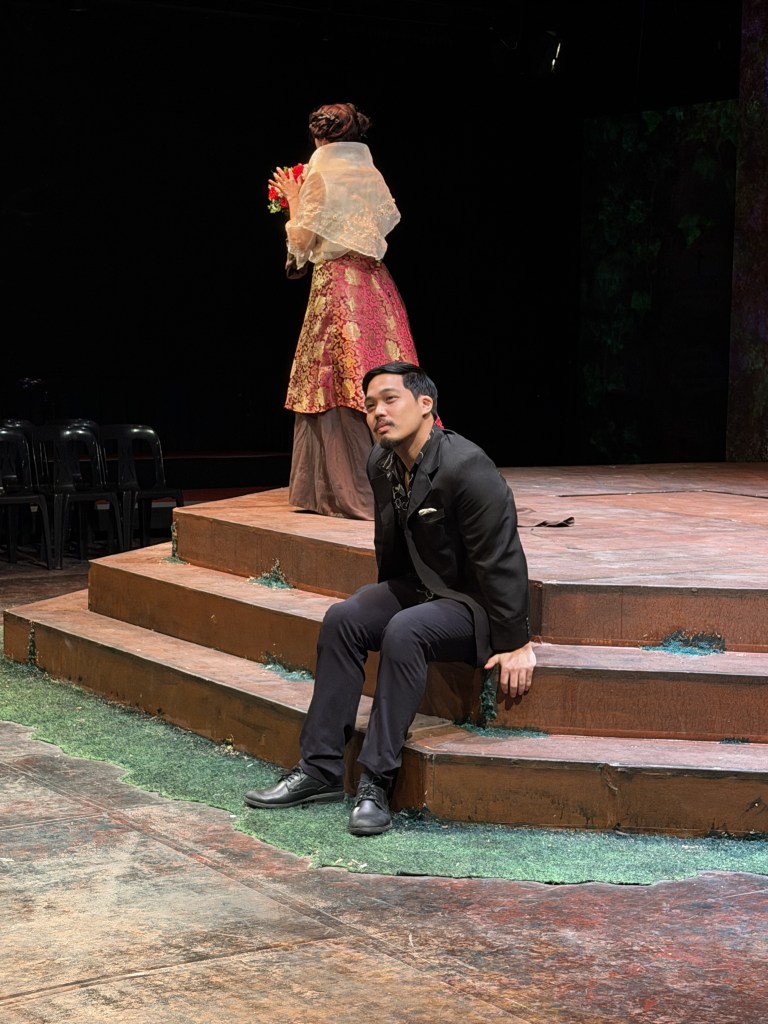
Similarly, Maria Clara’s transformation marks a shift from a tragic symbol of victimhood to a stark embodiment of systemic rot. In Noli Me Tángere, her descent into the nunnery unfolds slowly and painfully through letters and subplots. In Fiestas y Muertos, her tragedy is concentrated visually and textually in San Diego’s carnivalesque setting or in the immediate aftermath of a public spectacle. The contrast between her bridal or festive attire and her psychological imprisonment becomes a powerful visual metaphor for the broader subjugation of the Filipino homeland under colonial and clerical tyranny.
Elías’s character also takes on greater resonance within this thematic framing. In the novel, he serves as Ibarra’s philosophical counterweight, debating the merits of reform and revolution. In the crucible of Fiestas y Muertos, Elías embodies the voice of the disenfranchised ancestors and the living dead who have already lost everything to the regime. His exchanges with Ibarra shed their academic pretense, becoming desperate, breathless conversations in the shadows of the festive lights that emphasize the immediate stakes of survival.
The villainy of Padre Dámaso and Padre Salví shifts from the psychological and satirical world of prose to the stage’s physical, spatial reality. In the novel, Rizal uses sharp wit across several chapters to expose their hypocrisy. On stage, they must feel threatening from the outset. Set against community celebrations, their schemes show how religious authority turns joyful traditions into tools for policing bodies and souls. Their sermons become performances within the performance, demanding submission as church bells ring.
Sisa’s descent into madness—perhaps the novel’s most visceral indictment of colonial cruelty—serves as the emotional pivot of Fiestas y Muertos. In prose, her wandering through the woods is solitary and heartbreaking. In a stage adaptation centered on festivals and death, her madness disrupts the artificial harmony of the festivities. Her cries for her lost sons pierce the festive music and shatter the community’s collective denial. She becomes a walking memento mori, a living specter the town wishes to ignore but cannot escape.
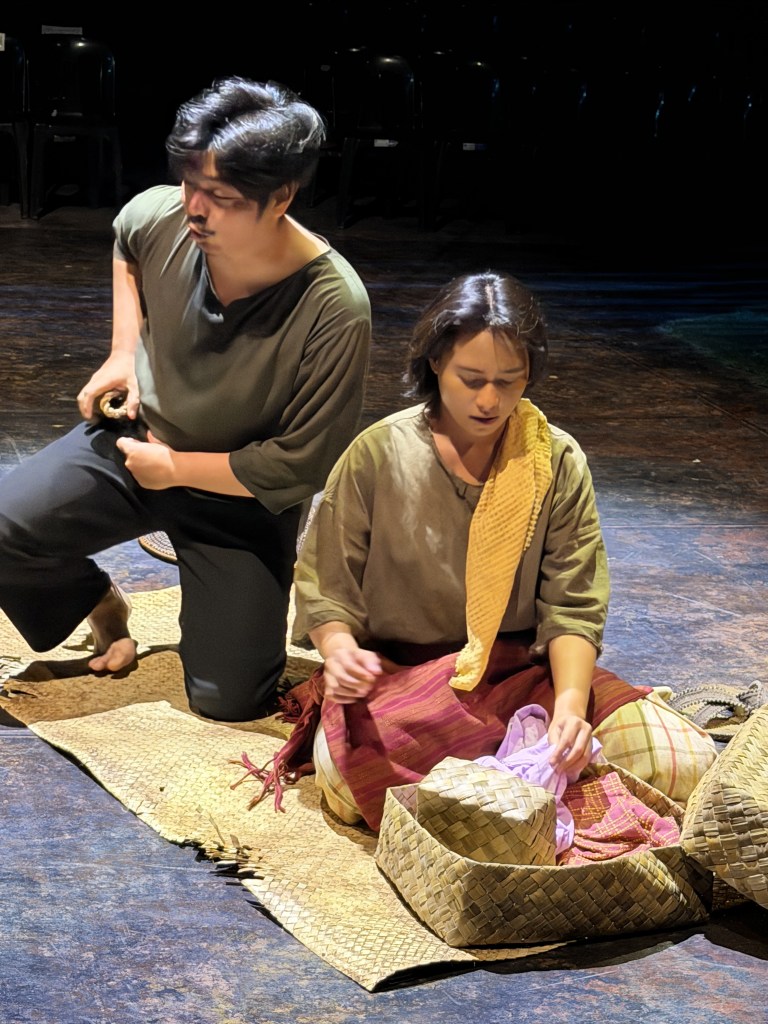
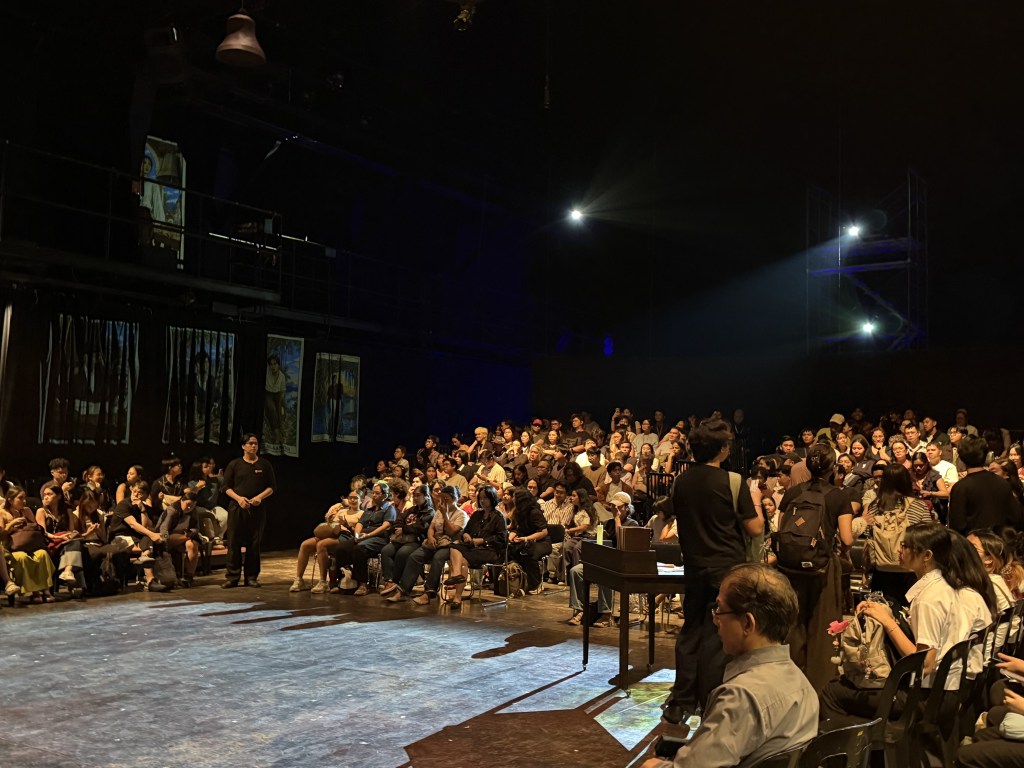
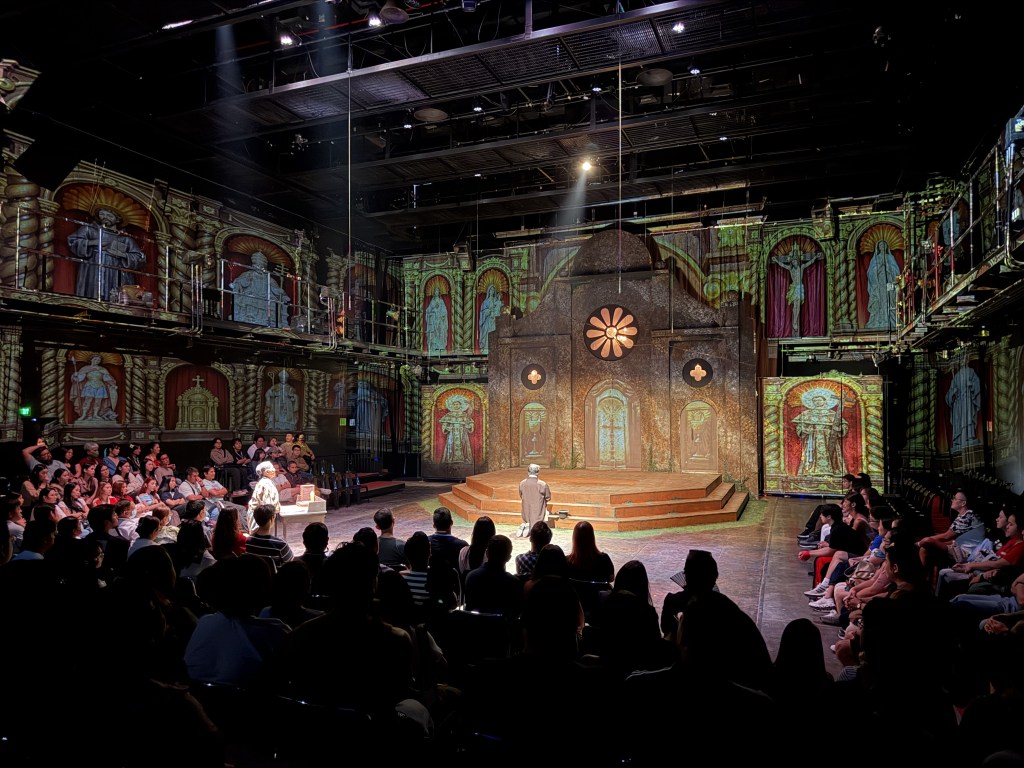
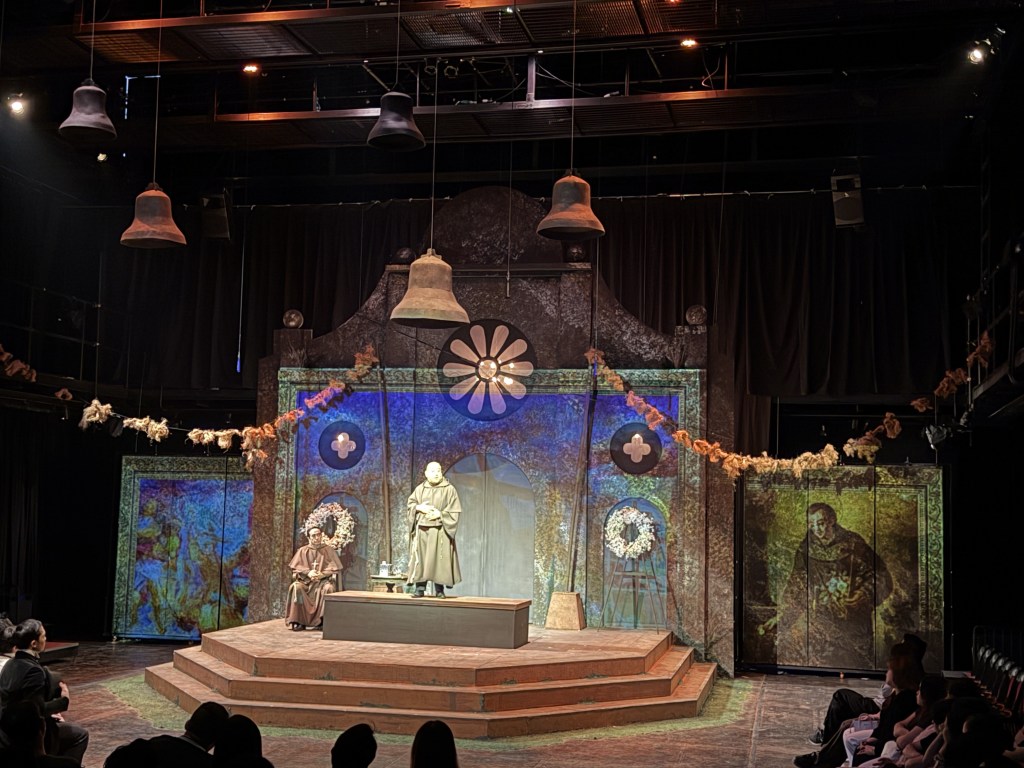
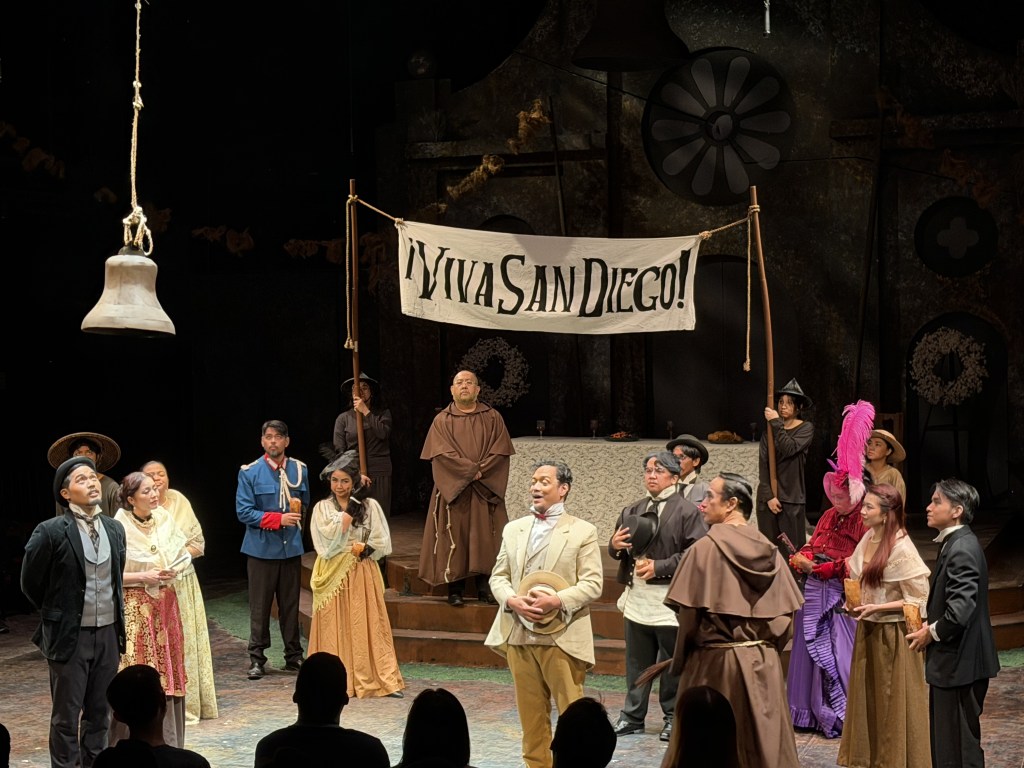
The clearest expression of this adaptation’s ideological reworking is its deliberate gender-flipping and renaming of the novel’s resident philosopher, Pilosopo Tasyo, as the matriarchal Inay Dorang. Fully revealed as Teodora Anastacio, she offers a dual tribute: her given name honors José Rizal’s mother, Teodora Alonso, while her surname and nickname connect her directly to the tragic brilliance of the original sage. By recasting the isolated, eccentric old man as a matriarchal pillar of the community, Fiestas y Muertos reframes colonial wisdom. Inay Dorang does not simply observe systemic decay from an intellectual distance; she bears the generational grief of a mother watching her country’s slow execution. This shift deepens the adaptation’s dialectical tension, transforming Tasyo’s abstract prophecies into a visceral maternal lament that directly challenges the town fiesta’s hollow artificiality.
This transformation seamlessly deepens the play’s atmosphere and themes by placing its critique of religious and colonial authority in domestic and communal life. Tasyo was an anomalous scholar mocked by the elite; Inay Dorang, by contrast, is a subversive maternal force whom the friars—especially Padre Dámaso and Padre Salví—find far more threatening to their carefully performed order. When she disrupts the festive harmony with sharp historical truths, her voice carries the authority of both teacher and ancestor, bridging the living and the muertos. Her exchanges with Crisóstomo Ibarra are no longer simply academic debates about reform; they take on the intimate gravity of a mother counseling her son on the brink of ruin. By honoring Rizal’s mother and his most enlightened character in a single female figure, the adaptation recasts women as more than passive victims of the regime: they become custodians of revolutionary memory and truth.
The expansion of Salomé in Fiestas y Muertos as a devoted disciple of Inay Dorang completes the adaptation’s matriarchal lineage of resistance, raising her from Rizal’s deleted romantic footnote to a vital agent of the revolution. At the tragic climax, she witnesses the consecutive deaths of her lover, Elías, and Sisa, the maddened maternal figure. This transforms her personal grief into a profound political awakening. Salomé inherits both Elías’s radical defiance and Sisa’s unavenged suffering, stepping into the void left by the muertos. Her potential future alliance with the surviving Basilio gives the narrative a powerful, forward-looking trajectory: she bridges the broken past and a revolutionary future, carrying Inay Dorang’s sacred flame of truth to the next generation of freedom fighters.
Furthermore, the adaptation reshapes the relationship between the story and its audience. Readers of Noli Me Tángere experience the tragedy privately, reflecting on its historical parallels at their own pace. Audiences of Fiestas y Muertos, by contrast, witness the exploitation together, confined in the same room with their ancestors’ suffering. This collective witnessing turns the performance into a civic ritual, echoing Rizal’s original intent to expose the “social cancer” on the steps of the public temple so that a remedy might be found.
The transformation of Noli Me Tángere into Fiestas y Muertos highlights the timeless adaptability of Rizal’s masterpiece. The novel’s significance lies not only in its historical plot, but also in its profound insight into how power operates through cultural performance. By centering celebration and death, the adaptation gives modern audiences a mirror for examining today’s distracting fiestas and the muertos who go unavenged in contemporary society. Fiestas y Muertos is more than an abridged version of Noli Me Tángere; it is a deliberate ideological extraction, distilling the novel’s expansive intellectual energy into an emotional, rhythmic tour de force. Through its portrayal of Rizal’s characters and conflicts in the context of institutionalized joy and systemic mortality, the play honors the original’s revolutionary spirit while demanding an immediate, visceral response from modern spectators.
The devising and dramaturgical sessions for Fiestas y Muertos were partially subsidized by the research project Contemporary Theatre Makers: Politics and Engagement, Community and Innovation (2626216 ORG)funded by the University of the Philippines Diliman Office of the Vice Chancellor for Research and Development through the Outright Research Grant.

