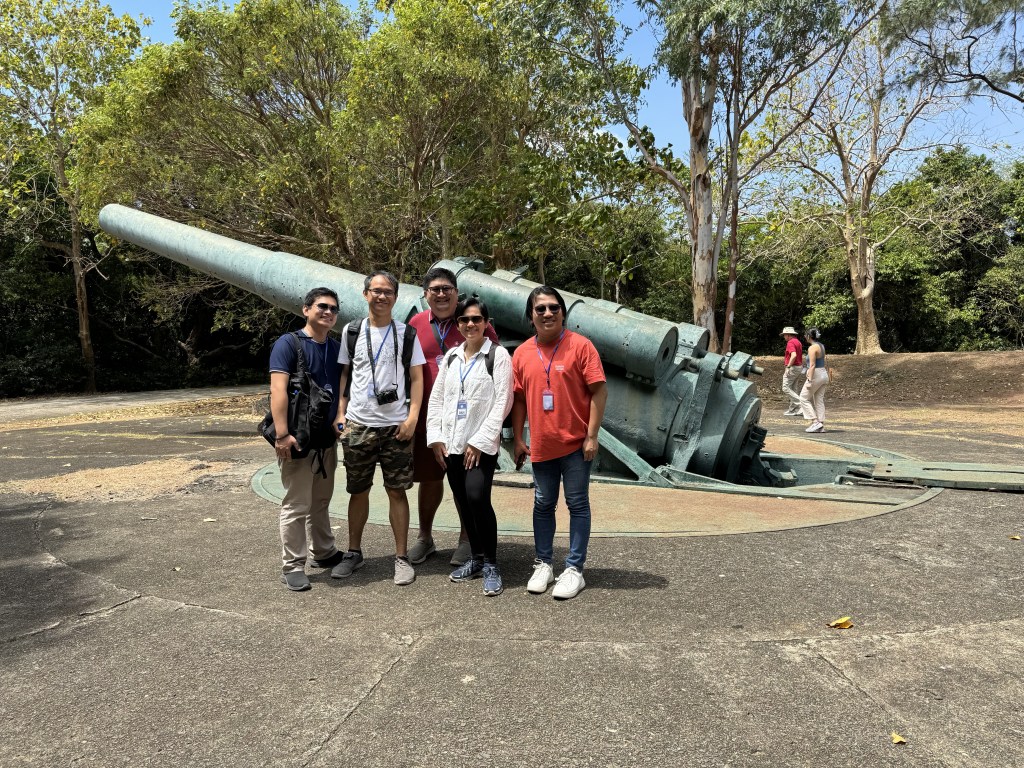
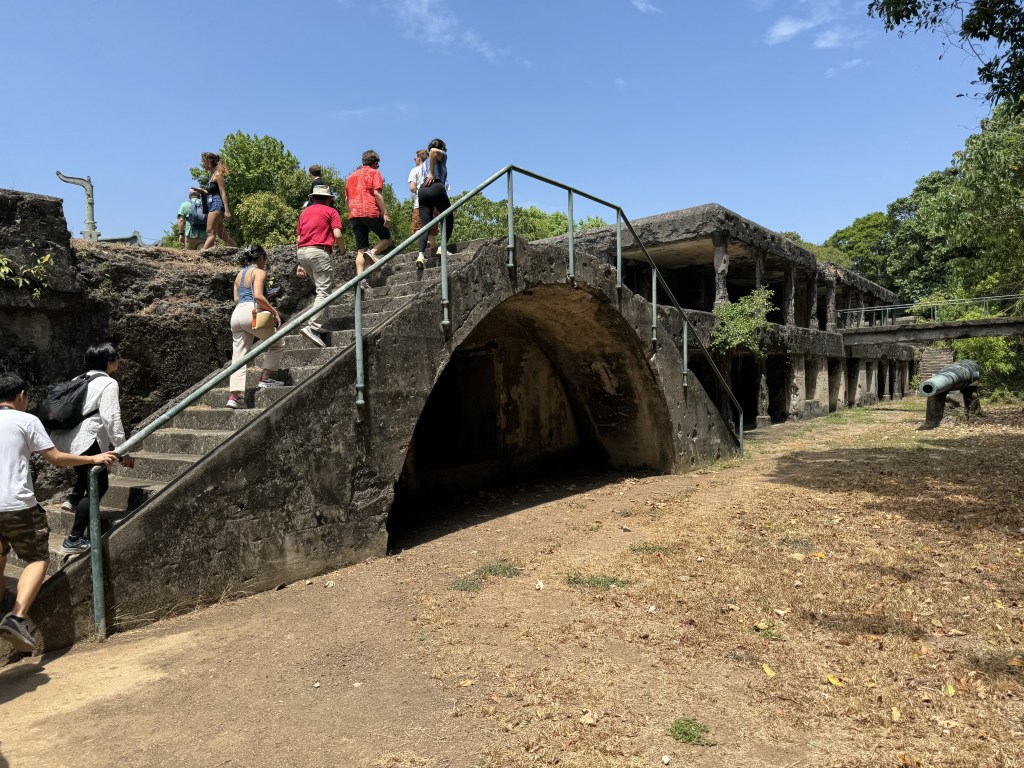
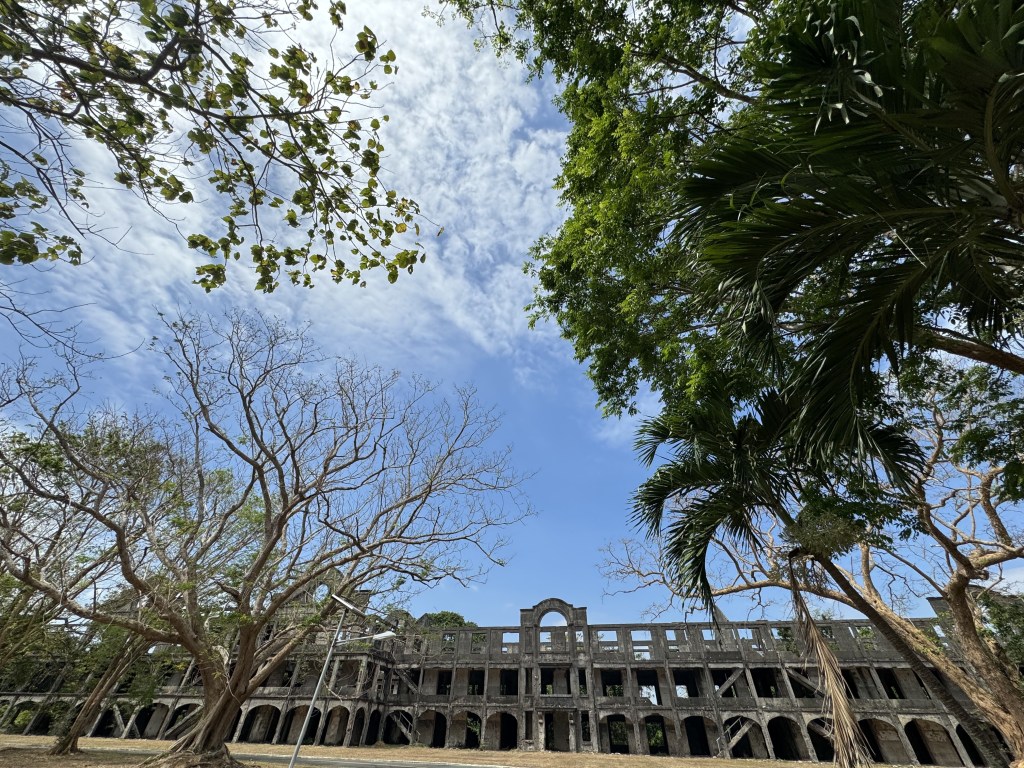
Quoting American poet, orator and Catholic priest Abram Joseph Ryan, our tour guide pointed the significance of Corregidor as an “island-striving-in-ruins.“ He proclaimed in jest “a land without ruins is a land without memories – a land without memories is a land without history.” In relation to the quote, the tour guide also explained that appreciating these ruins is of importance to them because it is part of their history. The charm of Corregidor is coming from the ancient buildings destroyed by the war between 1941 and 1945, says the tour guide: “These buildings are our history.”
This short script of our guide implicated three concepts: space (land), memories, and history. Adding here is performance. I thought the entire experience of Corregidor was one exciting performance. The tour guide was performing his knowledge of history – in fact, he was performing a persona of authority about the island. But he was a good storyteller – a persuasive orator. He was funny, relaxed, and confident.
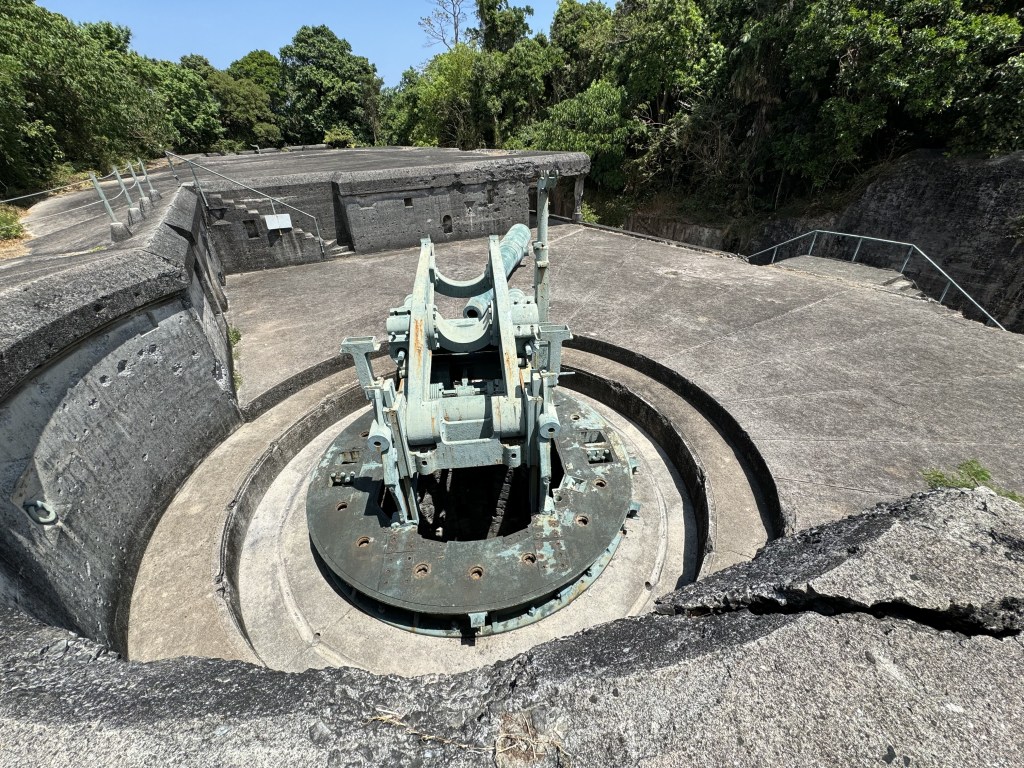
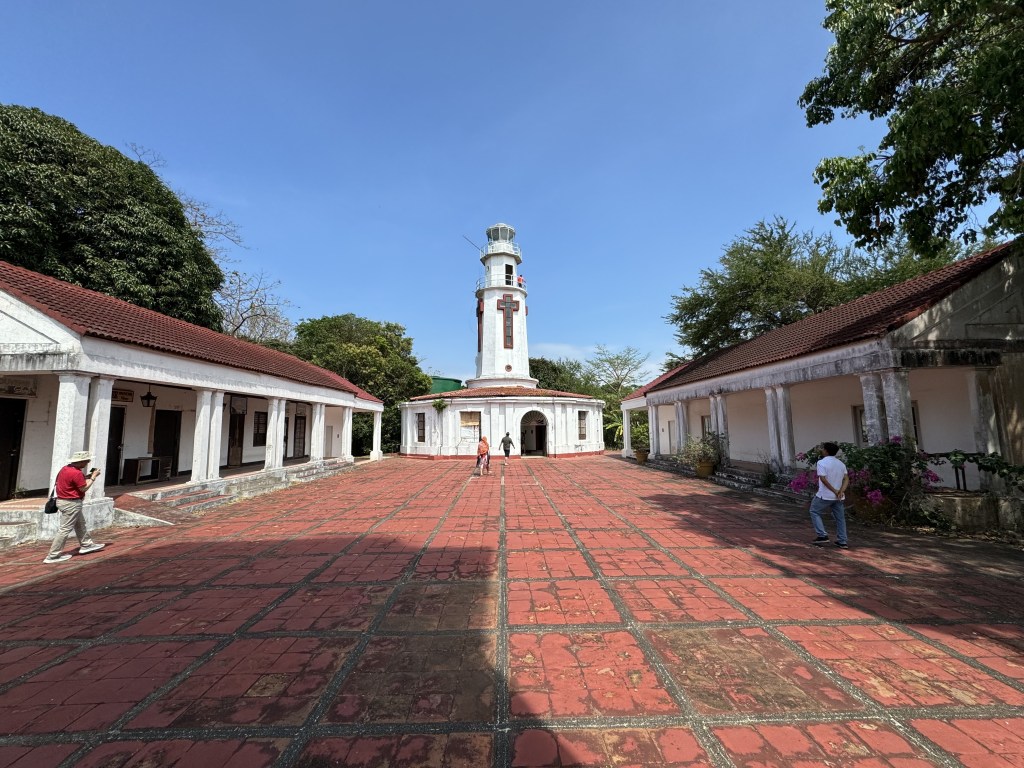
Then, I thought the island was performing history through the different ruins sporadically spread all-over it. Not to mention, I thought the island was also performing memories through various sites of memorialization: from the Japanese garden to the Filipino memorial to the batteries and to the Pacific War Memorial.
I should not forget mentioning that the management also transformed the island into a spectacle – I was referring to the transformation of Malinta Tunnel into what performance scholar Craig Latrell calls “heritainment” or the exhibition of authentic-seeming cultural forms while entertaining and imparting easily recalled images and narratives. In the case of Malinta Tunnel, the spectacle was sort of heritainment because there was the exhibition of authentic sensibility of a historical event that entertains and educates tourists or visitors. Was this not reenactment? While we can think of the light and sound show as a sort of reenactment albeit technologically mediated, the goal of reenactment is not really to absolutize what really happened in the past. In the case of the Philippines, it is interesting to note, at least in many reenactments I have witnessed (e.g. Cebu’s Battle of Mactan and Bataan’s Death March), local tourism offices are in-charge of these spectacles, with a clear intention of drawing crowds (non-locals) and the eventual development of the presentation into festival. Reenactment or note, it is an entanglement of entertainment, ingenious spectacle, story-telling, and history.
The experience of Corregidor was an experience of a performance which brings up front the integration of space, memory, and history. While understandably, simply looking at the ruins does not guarantee a complete recuperation of a historical past. And memory, in historiography, may be supplemental to the archive, but it cannot completely serve as a reliable material for history writing. Memory can always trick us – what it remembers is as much as what it forgets. Many scholars are convinced that a space is a witness to several historical accounts. However, the space cannot speak for itself. Even the state is capable of altering the integrity of a space, depending on how the current ruling party establishes the necessity of marking it as a heritage site or not.
However, the archive, despite it being considered as a sacred abode of power as it is where knowledge is traditionally and commonly incubated, conceived, and articulated, we tend to forget that what we can acquire from the archive are simple traces of the past and not the actual past itself. The playfulness of the archive is dependent on how it is played by those looking at it. Same goes with the ruins and performances in the island – these are sites of memories – and at best, also traces of the past. Like the writings in the archives, these are important in historical narratives because as Paul Connerton notes, these are perceptible to the senses. In epistemology, let us not forget that judgement is derived after perception and sensation. In this sense, like the documents in the archive, the ruins and the performances encountered in Corregidor, may be considered as gateways to the inaccessible past.
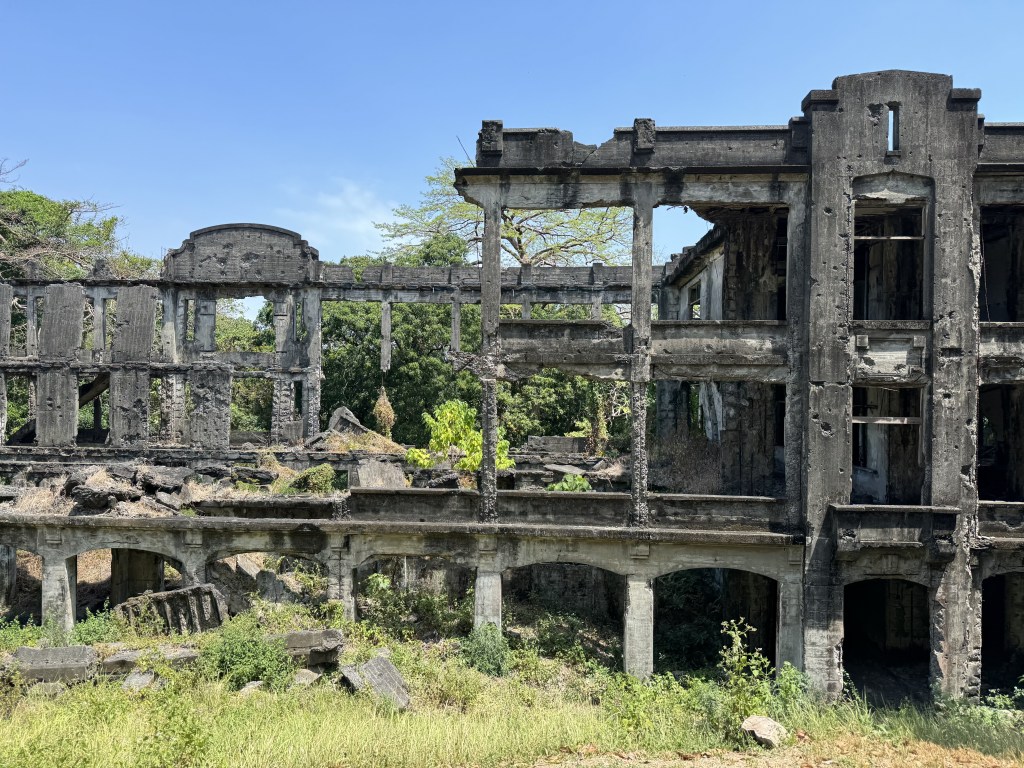
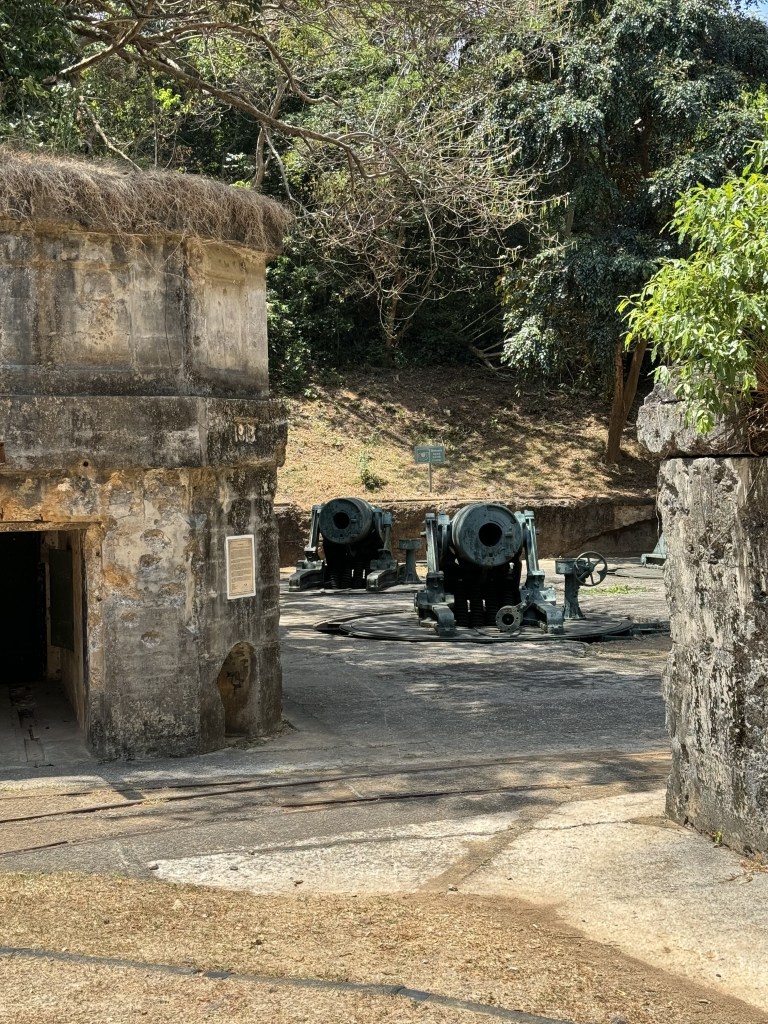
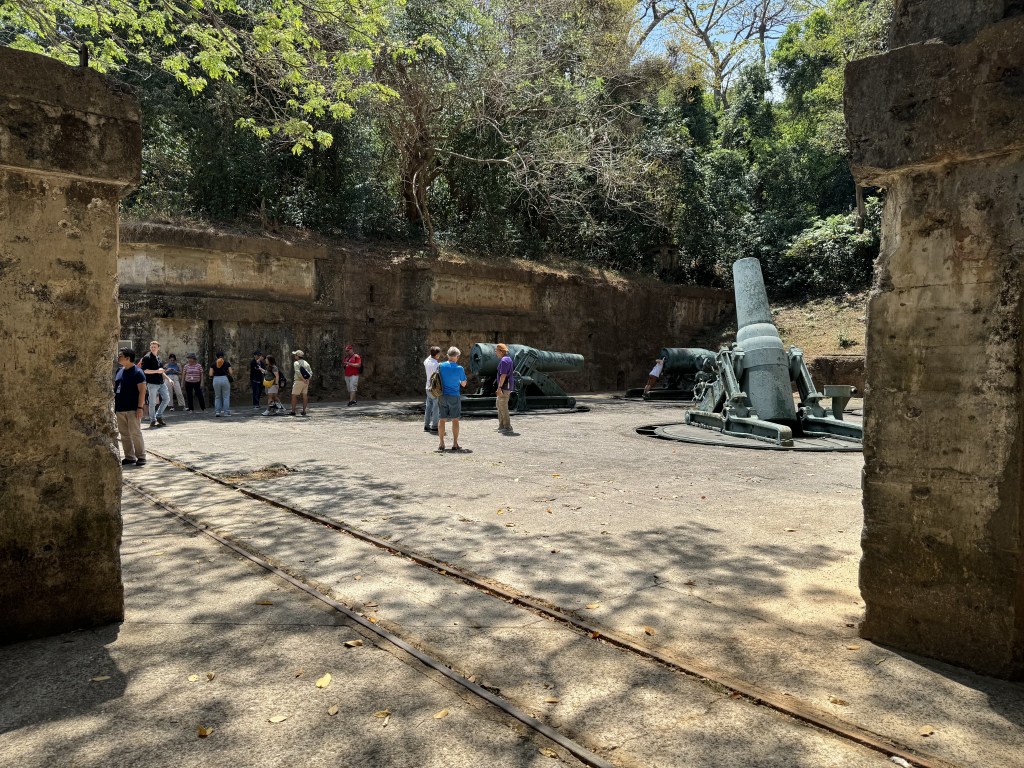
Since these are traces, we are reminded that like historians, we continuously construct and reconstruct the past based on the needs of the present. Often, these constructions and reconstructions surface as myths, which are also necessary for the survivability and continuance of a community (or the survival of the individual in a community). Often, we think of these as creative strategies to assert a cultural identity or a political identity. Or in the case of historical construction, a historical narrative devoid of the colonial tropes – a decolonized story-telling.
But there is also a huge amount of danger in this cycle of construction and reconstruction – the tendency to create lies. These are the overflows, the exaggerations, or the excessive narrations, which are not seen affirmatively on many occasions. The problem is its association with the revision of history for the gain of a selected few (i.e., political elites). This kind of “overflow” is twinned with the fear of spreading disinformation.
An example, in the context of the Philippines, is the plan of the national government in 2018 during the administration of then-President Rodrigo R. Duterte to revise history textbooks in primary education with annotations that the Martial Law era in the 1970s was a golden age of the Philippine economy, culture, and society. However, the Martial Law era in the Philippines was a two decade of corruption, human rights abuses, and the dwindling of the Philippine economy as evidenced by overwhelming data in various archives. What this 2018 overflow of historical narration wanted to do was ask the Filipino people “to move on by simply forgiving and forgetting the horrors of the Martial Law. Surprisingly, textbooks in high schools and some private universities are not even discussing Martial Law as turmoil in the development of Philippine modernity” as I discussed with Bryan Viray in a paper in JATI: Journal of Southeast Asian Studies, albeit totally different context.
And I think I encountered some overflows in this experience. At one point, some of these are necessary, in my view. For example, every so often, there was a rearticulation of the island as located strategically in the corner of the West Philippine Sea and the Manila Bay. Sporadically, everyone in the tour heard stories about pre-Hispanic people toiling the land and welcoming traders. But later you hear the guide talking about how barren the island. There was also a narration from the tour telling everyone on board that prior to Hispanic colonialism, it was the entry point for other islanders to register their presence or their desire to enter Manila or Luzon via Bataan Peninsula. This to me is to articulate that the Philippines as geographically blessed that aided the archipelago in shielding the Japanese intruders to easily access Manila, which at that time a very important open city in the Far East. But other overflows are presumptuous, methinks.
In the whole duration of the tour – the entire 5 hours – listening to the performance of the tour guide and attending to the heritainment inside the Malinta Tunnel, I thought I was listening to the history of the United States based on the cultural memory of a Filipino individual, which is quite weird, in my view. All throughout, we heard how the Americans did this and how the Americans did that. The significance of MacArthur in the history of the island, and placing Filipino figures not even in a supporting role, but as “extras.” I will not forget the joke of the tour guide when we passed by the sculpture of General Douglas MacArthur: “say hello to my great-great grand uncle!” The sculpture was located estimably 200 meters from where the tour started. From there to our first stop, our guide narrated a sort of a “build-up” on MacArthur’s bravery, love for Corregidor, leadership, and humility. In contrast, upon reaching the Filipino’s Memorial where images of Manuel Luis Quezon, Sergio Osemeña, and even Jose Rizal are found, no narratives about their courage, love for Corregidor or may be even for the Philippines, their leadership, and humility. Did he assume we know the stories of these figures? If so, why did he not assume the same when we passed by MacArthur’s sculpture.
While every now and then, we hear some remarks that Filipino soldiers engaged in battles against the Japanese imperial army, the role of these soldiers is so vague vs. the way the American soldiers bravely faced the enemies as they engaged them via the batteries.
On our way to the highest point of the island, I will not forget the witty joke of the tour guide when we passed by a US Flag. He first asked if we knew the number of stars in the US flag. Some replied correctly: 50. Then he asked if we were aware about the last state that joined the USA. No one replied. He gave us the answer: Hawaii. His final question: which do you think will be the 51st State? Several answers were given by the participants. Guam uttered one. I even thought of Puerto Rico as a possibility. When everyone gave up, he remarked: “the Philippines! Don’t you think so? It is a hope.” Everyone laughed at the joke. Even me was laughing at it. But I realized his seriousness – he even sighed before continuing, “anyway” with a very sad tone. I guess he knew that the Philippines becoming the 51st State is never going to be a possibility. It was only after the tour that I thought Corregidor as a site of memory failed to remind us at that point about the independence of the Philippines from the Japanese and even from the Americans.
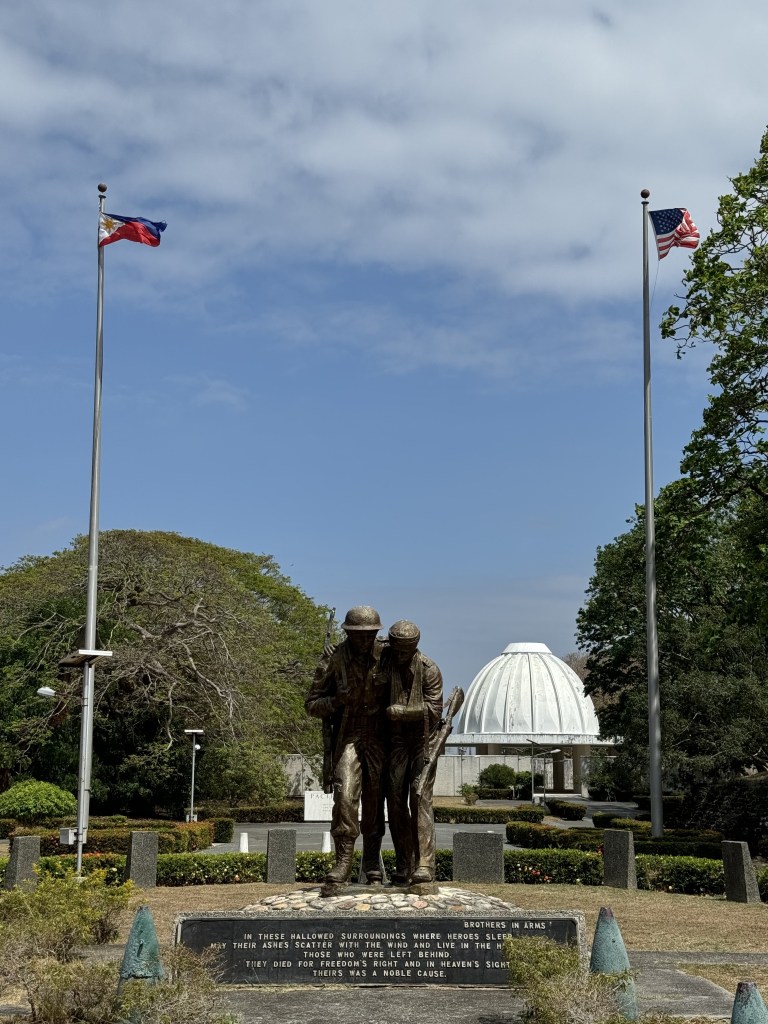
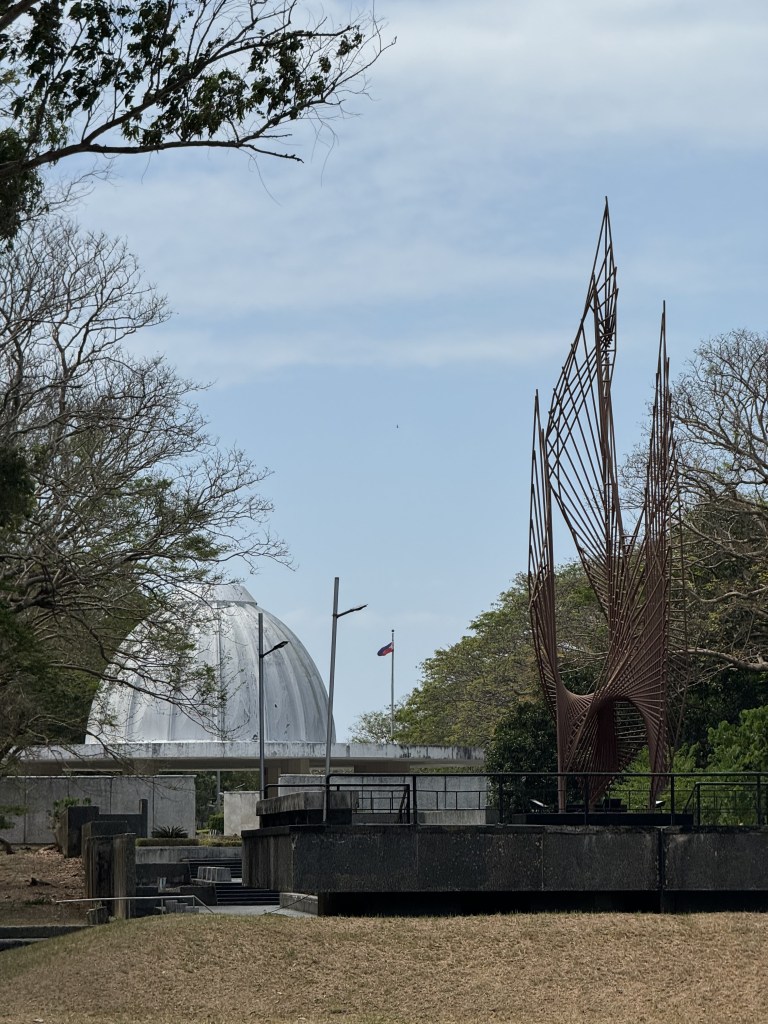
Then there is also the Pacific War Memorial, which I thought was the tour’s highlight for being the final spot before going back to the harbor. While this memorial eats a huge space, I focus on the sculpture “Brothers-at-Arms,” which honors the American and Filipino servicemen who fought in the Pacific Theater during the Pacific War. The piece stands at the entrance to the Pacific War Memorial, which was built by the U.S. government in 1968 at a cost of three million dollars. The inscription of the memorial sculpture says: “In these hallowed surroundings where heroes sleep may their ashes scatter with the wind and live in the hearts of those who were left behind. They died for freedom’s right and in heaven’s sight. Theirs was a noble cause.”
Looking at the sculpture, I then understood why these ruins and memorials serve as traces for a historical narrative where the Filipino characters are sidelined. The imposing structure tells us the valiant heroism of the American brother will always be there to support his weakling Filipino brother. There are some stark contrasts. The rifle of the American standing firmly while the Filipino’s pointing to the ground as if surrendering itself to the earth. The American stands tall while the Filipino stands short. The latter is bended – in pain, I assume, while the former stands with pride, communicating that despite pain, he is resilient.
To conclude this piece, I recall this experience at Malinta Tunnel. At the end of the show, the tour guide informed us to get ready to sing the Philippine National Anthem. It was surprising to see the Philippine flag, mighty standing on the pole. Then the voice-over was heard (not verbatim): “We were liberated by our American brothers. For the first time since the invasion of Japan, we felt singing the national anthem – our love song to our beloved Lupang Hinirang.”
On 9 April, we celebrated the day of valor – or the kagitingan ng mga Pilipinong indibidwal na lumaban para sa Bayan. I feel ashamed that when I sang Lupang Hinirang at the Malinta Tunnel, I was not even thinking of them. Together with the same students I brought to Corregidor, I visited Bataan to observe the reenactment of the Death March. Rightfully so, our Filipino soldiers during the Second World War, many of whom were teenagers, high-school students, deserve a memorialization and a proper recognition that they are the superstars of our war narratives. And let us not forget, a lot of women also joined the armed forces to help liberate the nation from whatever imperial forces.
 Tanghal Kultura