
And of course, Aachen is a world wonder because its cathedral (Aachen Cathedral) is another UNESCO World Heritage Site.
My third time in Germany, second time in Cologne. This time, on official business, as an Executive Committee member of the International Federation for Theatre Research, whose members met at the University of Cologne for the federation’s annual conference from 9 to 13 June 2025. Having exhausted the city during my first visit in 2016, I went to Cologne’s neighboring city, Brühl, and was in Aachen just this morning.
Aachen is a bad city near Germany’s borders with Belgium and the Netherlands. Bad in German is literally translated as mineral spring. There are several bad cities and towns in Germany. These towns were once bath cities of the Roman Empire. In this regard, Aachen is a spa city in Germany. It is filled with mineral and spring hot water. Today, Aachen is considered a resort city based on its mineral spa. Patrons visit the city to jump into the mineral waters of Aachen’s spas for their health benefits. But my visit to Aachen was not an attempt to experience a German spa, but to see the grand cathedral, which is Germany’s first UNESCO World Heritage Site.
It was in 1978 when the United Nations instituted the WHS. Together with 11 sites (Galapagos Island, City of Quito, L’Anse aux Meadows National Historic Site, Nahanni National Park, Rock-Hewn Churches of Lilabela, Simien National Park, Historic Centre of Kraków, Wieliczka and Bochnia Royal Salt Mines, Island of Gorée, Masa Verde National Park, and Yellowstone National Park), Aachen Cathedral’s inscription was based on outstanding universal values. Specifically, the Cathedral was inscribed due to its strong imprint of both Classic and Byzantine tradition paving the way for Carolingian Renaissance, one of the prototypes of religious architecture which inspired several churches later on. At the same time, the Cathedral is considered an excellent and distinctive example of the family of aulian chapels based on a central plan with tribunes. Finally, it symbolises the unification of the West and its spiritual and political revival under the aegis of Charlemagne. The collection of the treasury of the Cathedral is of inestimable archaeological, aesthetic and historic interest (See UNESCO World Herirtage Site website for more information).
Aachen Cathedral was founded around 800 A.D. and a Gothic chancel was added later. Its Domschatzkammer (treasury) houses medieval artifacts, including the shrine of Charlemagne, who was buried there in 814 A.D.
The Cathedral is home to three historical traditions. First, it is the final resting place of Charlemagne, as mentioned earlier. The core of Aachen Cathedral, the Carolingian octagon, was initially constructed as Charlemagne’s palace chapel and also served as his burial site. After his death on 28 January 814, he was buried in his church; however, the exact spot is unknown due to a lack of documentation and the ambiguity of the physical evidence. However, he was probably buried in the “Persephone” sarcophagus under the west tower at the entrance to the octagon.
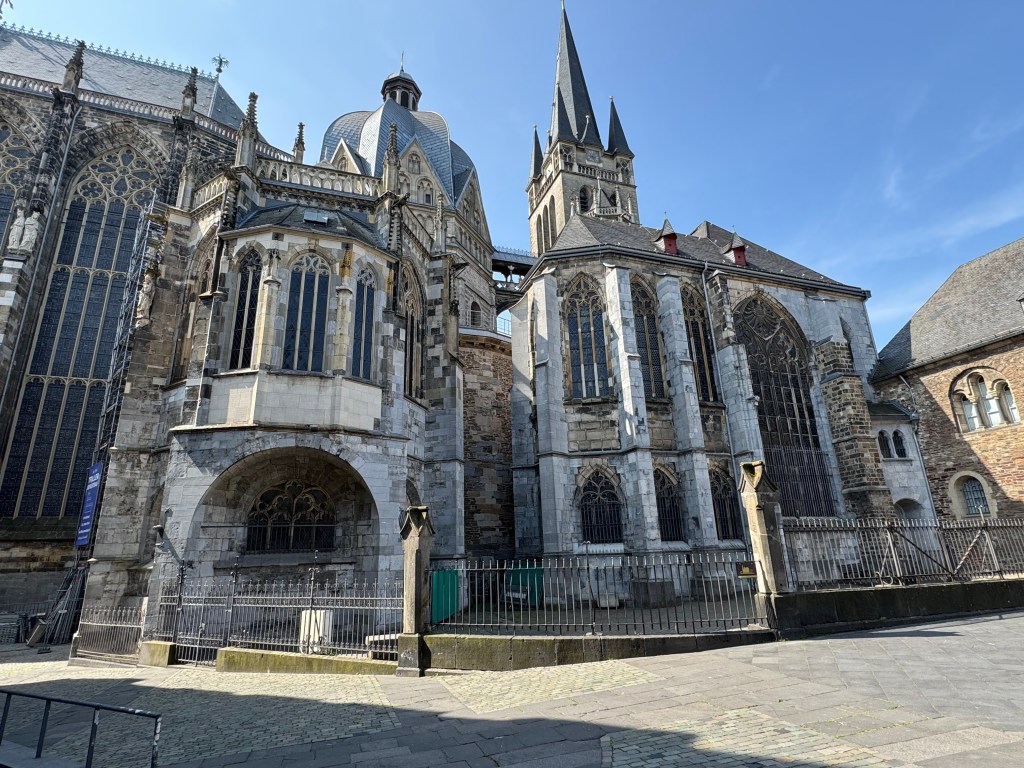


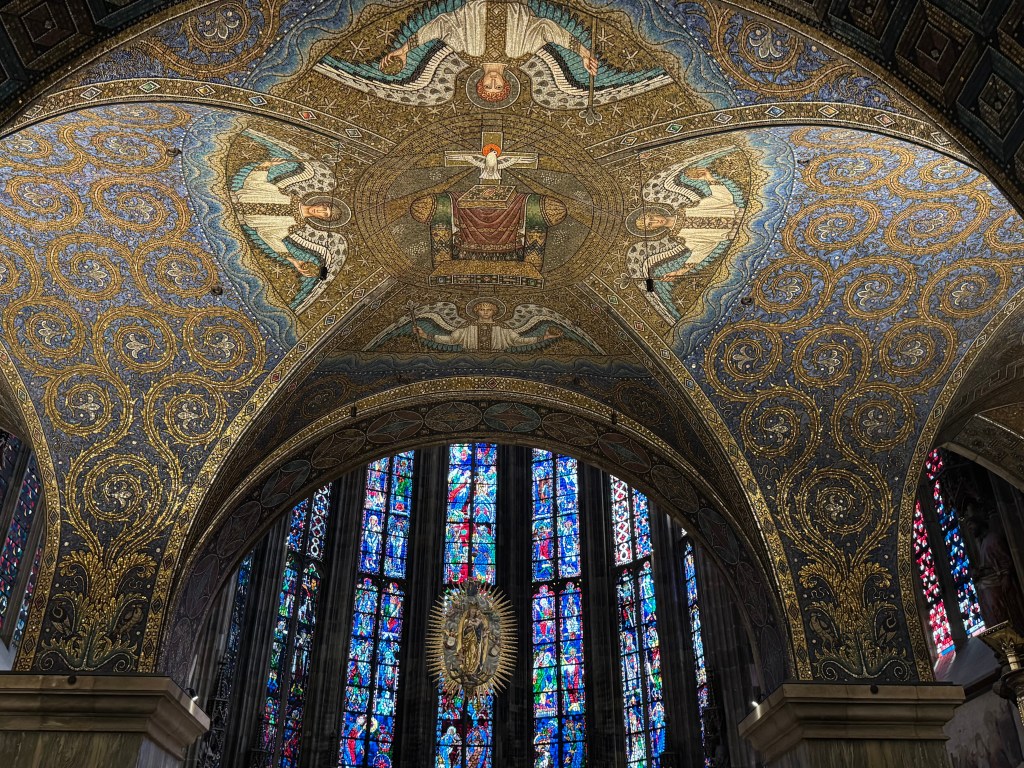

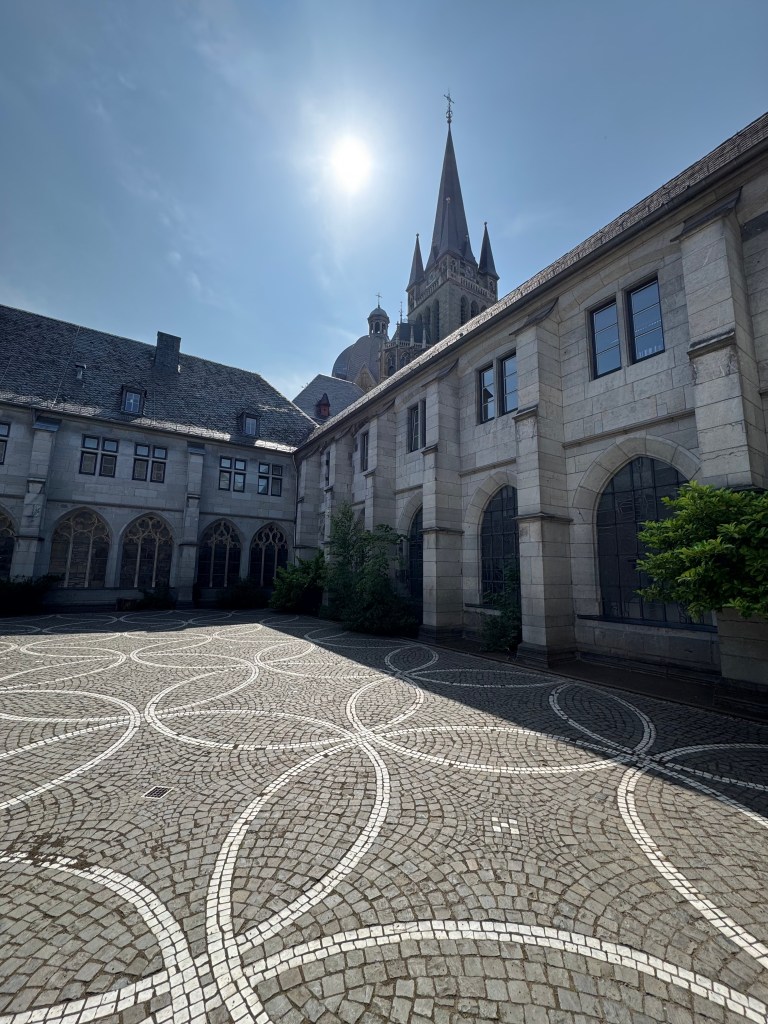
Second, it was used as the official coronation site of the Roman-German kings (from 936 to 1531). On the explicit instructions of Charlemagne, his son Louis the Pious crowned himself king in the chapel. Between the coronation of Otto I in 936 and 1531, thirty German kings were crowned in the chapel. The coronation itself occurred at the High Altar, followed by the enthronement on the Throne of Charlemagne (which can still be seen today). It is also notable that in this period, all German rulers, regardless of whether they were crowned in Aachen or not, took their position on Charlemagne’s throne.
Third and lastly, it is the home of Aachen Pilgrimage, which takes place every 7 years. The pilgrimage Aachener Heiligtumsfahrt is a religious devotion during which the four most important religious relics of the cathedral can be seen by believers, and is attested from 1238. Since 1349, these relics have been displayed once every seven years. The last pilgrimage was in 2023 and had the motto “Discover Me“. The relics are the Virgin Mary’s dress when Jesus was born, the swaddling clothes of Jesus, the loincloth of Jesus, which is believed to have been worn on the cross, and the cloth in which the head of John the Baptist was kept after the beheading. All four of these are taken out of the Church treasuries during the pilgrimage.
The Cathedral is a site of ecclesiastical services. It is still a functioning Catholic Church. Wedding ceremonies and other Church services are held inside the Church. This morning, there was even a wedding when I arrived.
The Aachen Cathedral is now on the list of my favorite religious monuments. As of today, it sits at the topmost rank in my list. The entanglement of function and aesthetics is an essential criterion for me. Historical significance, cultural significance, and representation of a creative genius are the other criteria. The next four on my personal list are (1) Don Bosco Cathedral and Brasilia Cathedral in Brasilia, (2) the Baroque Churches in the Philippines (especially Payao and Miag-ao), (3) Felix Romuliana in Gamzigrad, and (4) Fushima Inari Taisha in Kyoto.
 Tanghal Kultura