“Aren’t you glad – you are walking on the streets of your dream city?” commented my good friend and former officemate at the University of the Philippines Los Baños, who was visiting New York City for a few days en route to Winnipeg, his new home since more than a decade now. My friend and I were walking on the streets of what is known in NYC as the Theatre District, an area in Midtown Manhattan where most Broadway theaters are located. The district is bounded by West 40th Street on the south, West 54th Street on the north, 6th Avenue on the east, and 8th Avenue on the West.

Indeed, my friend is correct – NYC’s theatre district was my dream city. When we were traveling from Quezon City to Los Baños in Laguna, he remembered how fascinated I was with Broadway musicals. Playing on my car were songs from megamusicals and musicals of my generation: Rent, Jesus Christ Superstar, Wicked, Spring Awakening, Hairspray, and Urinetown, among others.
I arrived in NYC on 1 January, the first day of 2025. I am in New York for an Asian Cultural Council (ACC) fellowship to undergo dramaturgical observation and training in the city. In simple terms, my stay in NYC is to watch as many productions as possible, including Broadway megamusicals, musicals and plays.
Since my arrival, I have seen spectacular productions. & Juliet at the Stephen Sondheim Theater on 44th Street was my first taste of the Broadway theatre. It is a speculative musical about Anne Hathaway, Will Shakespeare’s wife’s proposal to rethink Juliet’s life not simply as a subject of Shakespeare’s imagination but as someone who also decides for herself. This jukebox musical is based on the songs of my youth: from Backstreet Boys to Celine Dion to Britney Spears and N’Sync, among others (or the hits of Max Martin).


A reimagination of William Shakespeare’s Romeo and Juliet at the Circle in the Square along 50th Street with Kit Connor (Heartstopper) and Rachel Zegler (West Side Story 2022 and the forthcoming live version of Snow White) with Sam Gold as director. The re-imagination of the classic tragedy to the present-day Bronx neighborhood (or somewhat like Bronx) reverberated the Baz Luhrmann 1996 box-office hit minus the gender-bending innovation of this production. Thanks to the dramaturgs Michale Sexton and Ayanna Thompson for updating the text to the current generation.
Alex Timber’s theatrical adaptation of Moulin Rouge at the Al Hirschfeld Theater on the 45th Street is another jukebox megamusical adapted from the Baz Luhrmann’s 2001 jukebox movie of the same title imagines the Moulin Rouge narrative in Paris through the characters of Satine and Christian. I definitely enjoyed this one. Sadly, I was not able to catch the Aaron Tveit. I was a few weeks late.

The hilarious theatrical adaptation of the Meryl Streep and Goldie Hawn film-starred Death Becomes Her at the Lunt-Fontaine Theater on 46th Street with Megan Hilthy and Jennifer Simard as Madeline and Helen respectively.
A glimpse of an American dysfunctional family was presented in the play Cult of Love by Leslye Headland with a star-studded cast led by Zachary Quinto, Sheilene Woodley, Mare Winningham, Barbie Ferreira, and Christopher Lowell. The play was staged at the Hayes Theater on 44th Street.
Delia Ephron’s Left on Tenth, starring Jullianna Margulies and Peter Gallagher with Susan Stroman as director, staged at the James Earl Jones Theater on 48th Street.

Sanaz Toosi’s English was staged at the Todd Haimes Theatre on 42nd Street. Personally, I thought the play was a reminder that there is no such thing as a universal and global language that is English. At the same time, it presents how, in this day and age, English is used as a tool for neoliberal agendas such as migration and an aspiration of a utopic world.
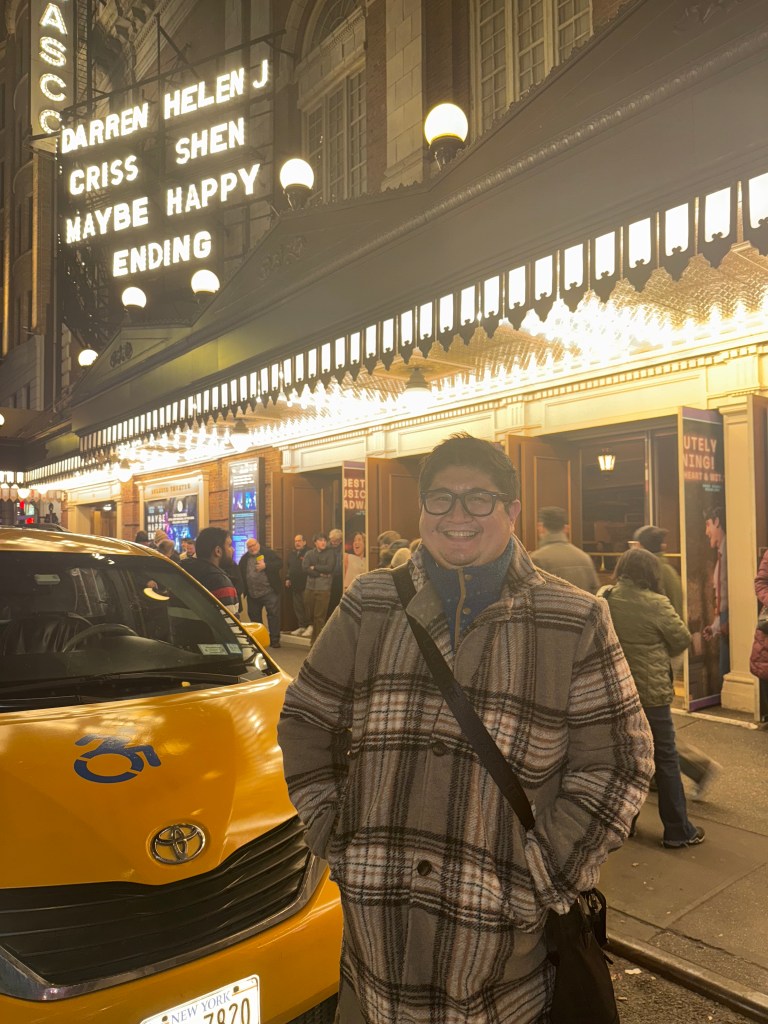
The one-act musical Maybe Happy Ending by Will Aronson and Hue Park and directed by Michael Arden is a very cozy musical that I enjoyed so much due to various Asian tropes that I am pretty familiar with. The musical was staged at the Belasco Theater on 44th Street.

At the Nederlander Theatre on 41st Street is Redwood, a new musical by Tina Landau, Kate Diaz, and Idina Menzel. Landau is also the director, while Menzel is the lead star. As I mentioned elsewhere, Menzel is haunted by the color green – a literal green-skinned witch in Wicked to a lover of the redwood tree, a lush green, tall, and sturdy tree in the Californian state. The musical reminds audiences that grief is a long, tedious, but necessary process. And yes, it made me cry – a little.
On 45th Street, at the Lyceum Theatre, is Cole Escola’s Oh Mary (directed by Sam Pinkleton), which presents a reimagination of the assassination of US President Abraham Lincoln in a very, very, very humorous way. Note, I used the word very thrice because it was really, really, really (again thrice) funny. It was a brave retelling, methinks, because if this historical narrative is presented in the Philippines, I am afraid, it might be labeled as historical revisionism.
My most recent Broadway theatre experience was Jamie Loyd’s reimagined Sunset Blvd. staged at the St. James Theatre on 44th Street. So far, this is my favorite musical. It decentered a lot of apects of the megamusical genre – from the costumes, to the set, to the staging, and even the acting choices. It was refreshing to see how film and theatre are interjected, especially since the musical follows the narrative of Norma Desmond, a movie star in the golden age of silent movies. Nicole Scherzinger’s Norma Desmond was outstanding. It was technical as much as it was emotional. Tom Francis’s performance as the young Hollywood wannabe and struggling writer was also superb – very intense, sincere, innocent, and ironically scheming.
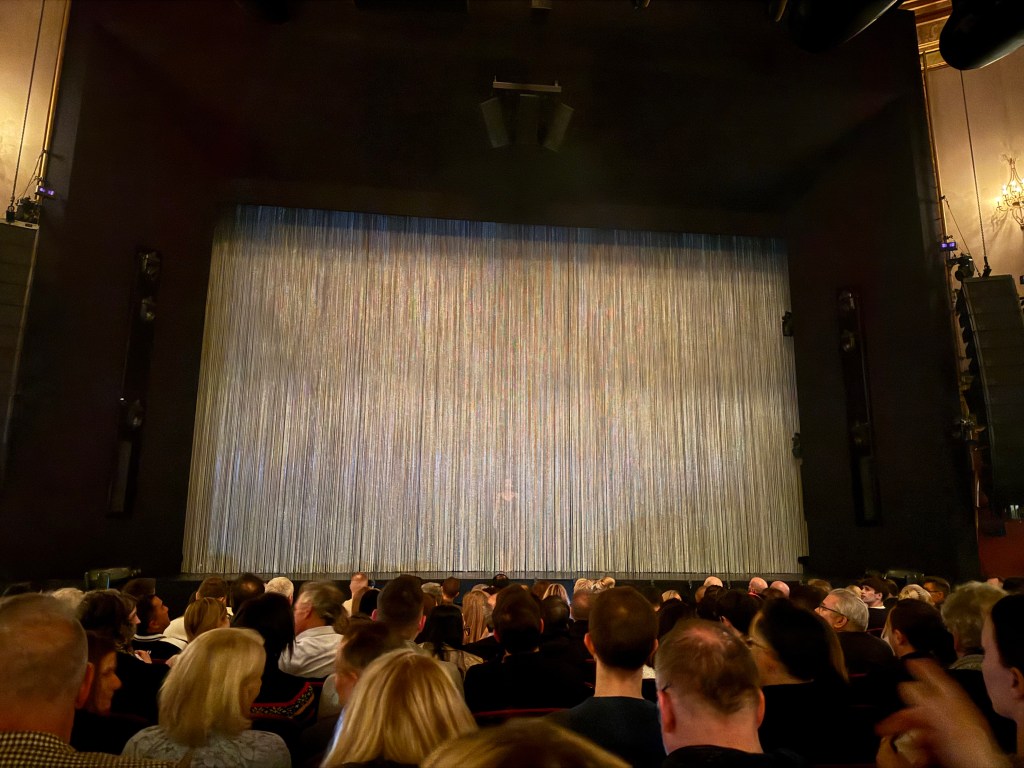
As I entered the theater houses of the NYC Theater District, I had a realization.
These auditoriums are cultural treasures, as are the staged productions. The theater houses possess historical and cultural significance. The beginning of the theater district can be traced to the 19th-century during the influx of immigrants to New York City, particularly Europeans (Germans and Italians), who brought their theater forms: burlesque, minstrelsy, and variety, among others. As NYC expanded north due to the increase in population, new theaters were constructed along the thoroughfare of the long stretch of Broadway Street with family-friendly vaudeville, developed by Tony Pastor. This was also the period when larger auditoriums for operas were erected. From the tip of Broadway Street in South Manhattan to Times Square, theater houses were home to large-scale theatre productions, mostly musicals, which lasted until the Great Depression. The concentration of theater houses along Broadway Street is the reason behind the popular alias Broadway Theatre of the NYC Theatre District.
The District saw the birth of the first American musical (patterned after the theater forms of the European immigrants). According to musical theatre scholars such as Will Everett, Laura MacDonald, and Paul Laird the first truly American musical is the Black Crook, a Faustian romantic comedy musical produced in 1880. Since then, Broadway Theatre has been home to critically and commercially successful musicals by Leonard Bernstein, Marvin Hamlisch, Burt Bacharach, Ricard Rodgers, and Oscar Hammerstein II. NYC Theatre District also gave birth to playwrights that formalized American drama: Arthur Miller, Tennessee Williams, Thornton Wilder, Noel Coward, and Neil Simon, The District was also responsible for fine-tuning the megamusical. Beginning with Jesus Christ Superstar in the late 1970s and the formalization of the genre through Cats, the NYC Theatre District gave birth to other megamusicals such as Beauty and the Beast, The Lion King, Wicked, and Hamilton. It also paved the way for refining new plays (known as workshop in the theatre jargon) and the emergence of the Off-Broadway and Off-Off Broadway shows.

At present, the theatre district is home to more than 100 theater houses, but only 41 are considered Broadway theatres. The Actors Equity provided the criteria for a theater house to be considered a Broadway auditorium: (1) has a capacity of over 500 seats; (2) produces mostly legitimate theater productions; (3) generally within Manhattan’s Theater District with the exemption of Vivian Beaumont Theater); and (4) the auditorium is under an Actors’ Equity “Production” contract if the theater is for-profit, or follows an Actors’ Equity contract if the theater is run by a non-profit.
In my view, the Theatre District is a potential World Heritage Site. Collectively, these theatre houses possess outstanding universal values. As per the criteria of UNESCO, the district represents a masterpiece of human creative genius. These theatre houses are architectural wonders that are very decorative but, at the same time, very functional. The designs of these theatre houses are a testament to the Neo-classical and Neo-Gregorian architectural traditions of the period. In other words, the theatre houses, from the facades to the interiors and even the stages, are art objects. In relation to this criteria, these are outstanding examples of architectural ensembles that illustrate a significant stage in human history – the history of theatre, particularly that of the megamusical. Finally, these theatre houses bear a unique or at least exceptional testimony to a unique cultural tradition: the theatre tradition as both a form of entertainment and as a medium of social communion and political efficacy.
 Tanghal Kultura