
Pumpon ng mga Gunita: A Reminiscence Theatre and a Documentary Theatre
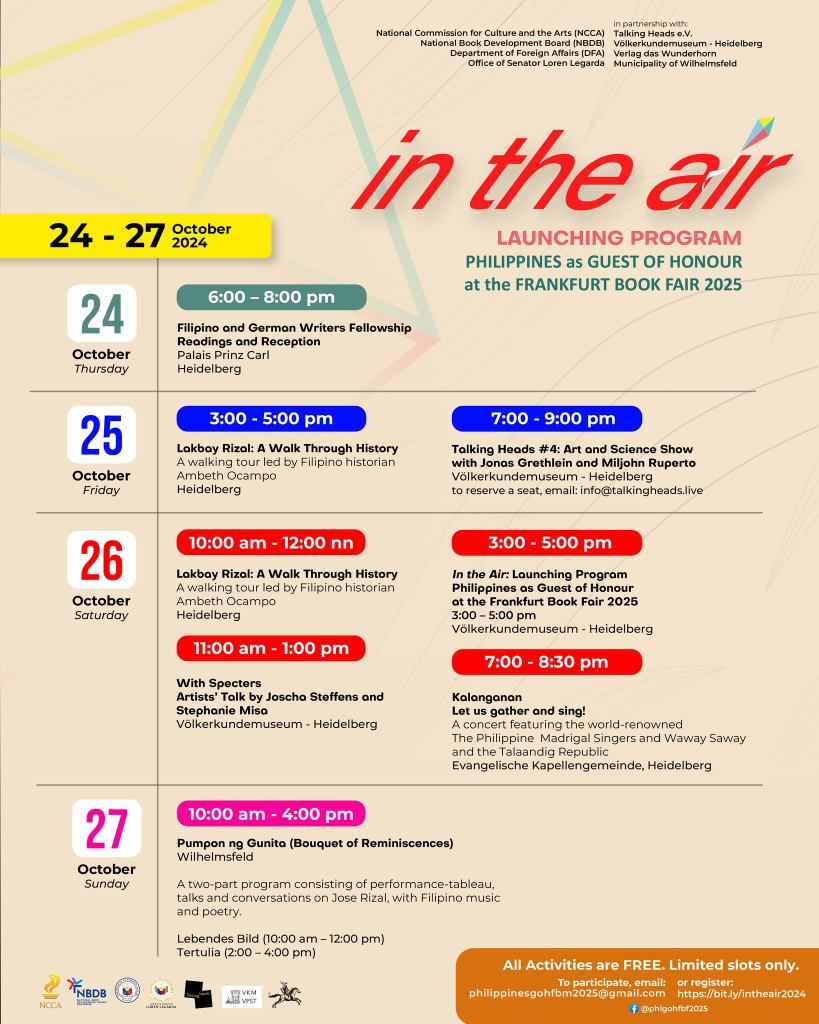
Staged at various locations in Wilhelmsfeld on 27 October 2024, Pumpon ng mga Gunita / Bouquet of Reminiscences is a performance of memory, retracing Jose Rizal’s reminiscences of, in, and with Germany. We think of the Pumpon ng mga Gunita as an experiential-learning performance about Jose Rizal’s affection for Germany and its people. It is also site-specific work, as the staging is specific to locations that were significant to Rizal when he was a resident of Wilhelmsfeld. Finally, the Pumpon ng mga Gunita is a “documentary” performance as it is also based on the writings of Jose Rizal (his letters to his family and friends, his poems, and his novels) and other documents written by his peers during the period of his one and a half year time in Heidelberg, particularly in Wihlemsfeld.


Why Germany? Why Heidelberg? Why Wilhemsfeld?
Jose Rizal’s affection for Germany and its people is evident in his many travel writings and letters to his family and peers about the country, which he called his “scientific mother country.” For more than a year, he moved from one German city to another, admiring the beauty of these Romantic places and immersing in many intellectual pursuits in other parts of the country. Berlin, the capital, for instance, is where Dr. Rizal’s most pivotal literary work, Noli Me Tangere, first came off the press, eventually paving the way for Filipinos’ pursuit of independence from Spain. However, Heidelberg has a special place in Rizal’s German sojourn.
On 3 February 1866, Rizal arrived at Heidelberg, where he studied the German language and met essential figures who influenced him as a poet, a medical doctor, a historian, a social scientist, and a nationalist: the Lutheran Pastor Karl Ullmer, the Catholic priest Father Heinrich Bafdof, the students from the University of Heidelberg, Wilhems Kuehne, among others.
Even though Rizal never attended the University in Heidelberg, it is important to note that he attended lectures by Dr. Javier Galezousky and Dr. Otto Becker, two ophthalmologists and professors at the university mentioned above who influenced his medical career. Traveling to Heidelberg is very important to him, primarily because of his desire to specialize in ophthalmology in order to provide treatment to his beloved mother, who at that time was already suffering from cataracts.
In Heidelberg and Wilhemsfled, he learned the value of spirituality over religiosity through his constant engagements with his host, Pastor Ulmer, and debates with Father Bafdof. Rizal also recognized the role of care and acceptance more than religious obligations as the centerpiece of community life. He cherished the motherland as he struggled with his homesickness, paving the way to write one of his most celebrated poems: “The Flowers of Heidelberg.” His appreciation of the natural environment heightened as he strolled along the beautiful natural and cultural landscapes around him – from the Neckar River to the Heidelberg Castle standing atop Königstuhl and to the serene countryside of Wllhelmsfeld.
This reminiscence theatre production commemorates Rizal’s sojourn in Heidelberg and Wilhelmsfeld. Using existing documents (letters and literary works), the goal of the performance is to vicariously experience the joy, the pains (i.e., homesickness), the desires, and the fears of Jose Rizal as a cosmopolitan Filipino figure. The performance is not a reenactment of Rizal’s life in Heidelberg. However, it is an entanglement of entertainment, efficacy, story-telling, history, and “imagination” (haraya) with an agenda of interrogating how a space (i.e., Heidelberg) is contributory to the critical position of an individual (i.e. Rizal) about ideas of a community.
This production is part of In the Air: Launching of the Philippines as Guest of Honour 2025 at the Frankfurter Buchmese. For more details, please click here.

Pumpon ng mga Gunita is directed by José Estrella.
Joining Estrella on the creative team are Sir Anril Tiatco and Jem Javier (Dramaturgy and Devise), Mark Dalacat (Set Stylist and Video Design), Stephen Artillero (Costume Stylist), Dean Icalina (German Translations), and Jose Buencamino (Original Score). The performance features Ross Pesigan, Wenah Nagales, Elora Españo, Paw Castillo, Dean Icalina, RJ Balledos, Unita Galiluyo, and the Philippine Madrigal Singers.

ENGLISH TRANSLATIONS OF SCENES FROM THE PLAY PERFORMED IN TAGALOG
About the Meeting of Crisostomo Ibarra and Pilosopong Tasyo
In Noli Me Tangere, we see the character of Tasyo, who, despite being called, “Philosopher” by the parish, experiences isolation from his community, given his commitment to rational thought over Church-ordered policy. In the excerpt, Rizal uses Tasyo to illustrate that Filipino society is ignorant while also showing the downside of embracing isolation, which leads to an irrational acceptance of obscurity. Tasyo argues that Ibarra must gain the Church’s support before building a school. This is interesting because it implies that, despite his own affinity for the freedom that comes along with isolation, Tasyo recognizes that an individual cannot bring about change if he is labeled a “madman.”
CRISOSTOMO: I’ve come to speak to you about a matter of importance. (Smiling slightly, he takes some documents from his pocketbook). I plan to build a school in my hometown, and I would like to have you advise me as to what persons in the town I must first win over in order to assure the success of the undertaking. You know the inhabitants well, while I have just arrived and am almost a stranger in my own country.
TASYO: This first thing that I advise you to do is never to come to consult with me. Because sensible people would take you for a madman also. The second thing I can advise is that you consult the curate, the gobernadorcillo, and all persons in authority. [B]ut consultation doesn’t mean compliance, although you should make it appear that you are taking their advice and acting according to it.
CRISOSTOMO: The advice is good, but difficult to follow. Couldn’t I go ahead with my idea without a shadow being thrown upon it? Couldn’t a worthy enterprise make its way over everything, since truth doesn’t need to borrow garments from error?
TASYO. That is good in theory and practicable in the world of which youth dreams. You have said that you are a stranger in your own country, and I believe it. The field in which you wish to sow is in possession of your enemies and against them you are powerless. It is necessary that you first kiss the hand that—
CRISOSTOMO: (Exclaiming passionately) Kiss their hands?! You forget that among them they killed my father and threw his body from the tomb! I do not avenge it because I have regard for the good name of the Church!
TASYO: Señor, if you preserve those memories, abandon the enterprise you are undertaking because to make it a success zeal and money alone are not sufficient; in our country the soil is not ready, it is only sown with discord.
Short silence.
CRISOSTOMO: (in low voice) Doesn’t your experience suggest any other than this hard means?
TASYO: It is not courage, but foolhardiness, to fight alone against all that exists. No one censures the pilot who makes for a port at the first gust of the whirlwind. To stoop as the bullet passes is not cowardly—it is worse to defy it only to fall, never to rise again.


The Madness of Sisa
JOSE: Sisa has one of the most tragic stories. Living in a poverty-stricken household and married to an abusive husband, Sisa started to descend into madness after discovering that her two sons—Basilio and Crispin—had gone missing. She was publicly humiliated by the guardia civil who were looking for her two sons, believing that they committed the crime of stealing in their hometown.
Jose exits.
Sisa enters.
SISA: My good Crispin! Accusing my good Crispin! It is because we are poor, and the poor have to suffer everything.
I want to save my sons: but how? Mothers do not stop to ask by what means, when it concerns their own flesh and blood. Mother of the thieves! My sons do not steal even when they are hungry. We are accustomed to suffering hunger. We who are poor, we are not all thieves!
Basilio, have you eaten? No? There are rice and dried sardines. Are you not going to eat? Then let’s lie down to sleep for it is getting quite late. Today, Señor Crisostomo Ibarra, the son of the late Don Rafael, arrived from Spain. He must be as good as his father was. Tomorrow I will go and see him, and I will plead with him, ask him to help me, and I will get Crispin. And since the old man Tasyo says Crispin is very intelligent, we will send him to Manila to study. And he will become a doctor.
Short silence.
Crispin! Basilio? Basilio! Crispin? Have you seen my children?
She exits.

Kabanata Ekis: Elias at Salome
In the original manuscript of Noli Me Tangere, there is an unpublished chapter, titled “Elias at Salome.” Due to financial constraints, Rizal removed it during the printing of the book in Berlin. The chapter was later on discovered and found to have had a large ‘X’ mark so that they called it “Chapter X.”
Elias embodies the Filipino masses who are aware of the injustices that their countrymen experience. Because of this, they also take on the role of delivering the oppressed from the oppressors. Meanwhile, Salome was likened to those little flowers in the field without color or fragrance, stepped on unwittingly, and whose beauty manifests itself only when examined with care—unknown, and of elusive perfume. The chapter narrates the affectionate feelings shared by the two characters. Because of his troubled and tragic past, Elias does not want Salome to marry him; instead, he insisted that she enjoy her life and her youth and marry a respectable and honorable man in the future.
In the excerpt, the entangling circumstances ultimately decided their fate—their poignant parting of ways:
Elias enters after exchanges of whistles.
Elias and Salome embrace.
SALOME: I thought you would come by water, Elias.
ELIAS: I couldn’t, Salome. The falua has come and is patrolling the lake. There’s a man in it who knows me.
Salome notices in his features and actions that he was sad. Deep in her heart, she knew that Elias was being sought by the authorities.
Elias rises, speaks in a low tone—
ELIAS: Goodbye, Salome. The sun is setting and, as you think, it won’t do for the people’s hereabouts to say that the night overtook me here—but you’ve been crying. Don’t deny it with your smile, you’ve been crying.
Salome was crying simply because she was sad at leaving this house where she was born and reared.
SALOME. Because it’s not right for me to live alone. I’ll go to live with my relatives in Mindoro… [T]o give up this house is something more than giving up a half of one’s being. A typhoon will come, a freshet, and everything will go into the lake.
Elias remains speechless for a moment, then holds her hands and asks her—
ELIAS: Have you heard any one speak ill of you? Have I sometimes worried you? Then you are tired of my friendship and want to drive me away—
SALOME: No, don’t talk like that. I am not tired of your friendship. God knows that I am satisfied with my lot. I only desire health that I may work. I don’t envy the rich, their wealth, but—
ELIAS: But what?
SALOME: Nothing—I envy them nothing so long as I have your friendship.
ELIAS: (with bitter sorrow) Salome, you know my cruel past and that my misfortune is not my work. [I]f it were not that I don’t want my children to suffer what my sister and I suffered, you would have been my wife in the eyes of God. But for the sake of this very love, I have sworn to end with myself the misfortune that we have been inheriting from father to son. You do well to go to the house of your relatives. Forget me, forget a love so mad and futile. Perhaps you’ll meet there one who is not like me.
SALOME: (Reproachfully) Elias!
ELIAS: Forget me. That, with your forgetfulness, I may be less unfortunate. Here you have no one but me, and the day when I fall into the hands of my pursuers, you will be left alone and alone for the rest of your life. Improve your youth and beauty to get a good husband, such as you deserve, for you don’t know what it is to live among men.
Short silence.
SALOME: I, I . . . was thinking that you might go with me.
ELIAS: Alas! Impossible, and more so than ever…I haven’t yet found what I came here to seek—it’s impossible! Today I forfeited my liberty.
Salome looks at him tenderly.
SALOME: Well, then, at least after I am gone, live here, live in this house. It will make you remember me and I will not think in that distant land that the hurricane has carried my hut into the water. When my thoughts turn to these shores, that memory of you and of my house will appear to me together. Sleep where I have slept and dreamed—it will be as though I were beside you—
ELIAS: (Waving his hand in desperation) Oh! Woman, you’ll make me forget.
Freeing himself from Salome’s clasp, Elias leaves hastily. Salome follows his fleeing form with her gaze, as she stands listlessly, listening to the sound of his footsteps that slowly fade away.


Reimagined Teodora Alonzo – Post-Cataract Surgery
This is an original piece devised by Tiatco and Javier with the help of historians Dr. Ma. Mercedes Planta (University of the Philippines Diliman) and Michale Bernal (based in Madrid, Spain).
Teodora Alonzo is seated by their house in Manila, recalling her son Jose’s successes as a doctor—of medicine, of society, and to the barrio. She just came from Dapitan, where Pepe was being exiled. Pepe had just operated on his mother with much success, as he was able to extract the cataract in Teodora’s right eye. She could see with much clearness immediately after.
TEODORA: I can finally see the lighthouse – is it the lighthouse at Intramuros? Oh, my Pepe! My dear, dear Pepe. Thank you.
Pause
We all know that my life in this world is already limited. But I am still grateful for this gift of sight!
My son is now a doctor. In Dapitan, he is queued by several patients, many of whom are from other nations. Even I—I was miraculously healed by my son. I am extremely proud of his success.
Of course, I am happy that my son Pepe is sharing what he learned from Germany to the people of Dapitan. But how can he not accept fees from his patients? How will he survive if his services as doctors are not consumated. He tells me that he doesn’t need money because his patients donate chicken, eggs, meats – as payments.
Takes another deep breath.
If he has to be the doctor to that barrio and if needed to cure the social cancer – then he will have to do it. This young man even finds time to philosophize. If only he was still a child, I could have pinched him. He insists that being a man of science, he also has a responsibility to his society.
Short silence.
I want to see – I want to use these eyes and see clearly. But I am terrified. Each time I open these eyes, these eerie and strange feelings are very overwhelming. I am terrified that one day when I open my eyes, clearly, I will see an unwanted scene.
Short silence.
If this perfect vision means submission of my son to their treacherous accusations, I don’t want them. I rather go blind if it’s the only way for me to save him from the fire of doom. My God, have mercy on my son. Have mercy on Pepe. My only wish is to see him home – home back to me, to his family, here in Manila. I will cook him his favorite chocolate pudding, noodles, and chicken soup.
Selected References Used in the Development of the Performance
Capino, Diosdado G. 1961/1962. “Jose Rizal and His Meaning for Germany.” Internationales Jahrbuch für Geschichtsunterricht 8: 183 – 194.
Embassy of the Philippines in Germany. 2017. “Retracing Rizal’s Journey Through Germany.” http://philippine-embassy.de/2017/07/06/retracing-rizals-journey-through-germany/. Retrieved 9 August 2024.
Enderun, Ink. 2019. Inspirierern: Stories of Jose Rizal in Germany. Enderun Portal Archive., 14 March 2019. https://ink.enderuncolleges.com/2019/03/14/inspirieren-stories-of-jose-rizal-in-germany/. Retrieved 10 August 2024.
Joaquin, Nick. 1991. Poems and Prose. Manila: Bookmark.
Mojares, Resil B. 2013. “Jose Rizal in the World of German Anthropology.” Philippine Quarterly of Culture and Society 41 (3/4): 163 – 194.
Ocampo, Ambeth. 2017. “Rizal in Wilhelmsfeld.” In Philippine Daily Inquirer Online, 15 February 2017. https://opinion.inquirer.net/101681/rizal-in-wilhelmsfeld. Retrieved 8 August 2024.
Ocampo, Nilo. 2001. Istilo Ko: Rizal Romantik, Mga Tala ng Pag-asam at Pag-ibig. Quezon City: Lathalaing PL.
Pahimakas. 2002. “Ang Huling Paalam ni Jose Rizal: salin sa Tagalog ni Andres Bonifacio” https://www.tagaloglang.com/huling-paalam-ni-rizal/. Retrieved 8 August 2024.
Paredes, Am.F. (1950, March). “Elias at Salome.” The Manila Guardian.
“Rizal-Blumentritt Correspondence: 50 Selected Letters Between Rizal and Blumentritt.” Unpublished documents, National Historical Institute.
Rizal, Jose. 1996. Noli Me Tangere by Jose Rizal (Soledad Lacson-Locsin, Trans.). Makati City: Bookmark.
Rizal, Jose. 2007. The Social Cancer: A Complete English Version of Noli Me Tangere (Charles Derbyshire, Trans.).
Rizal, Jose. 2011. Noli me Tangere. Trans. Virgilio S. Almario. Pasay City: Anvil Publishing House.
Roda, Ramon. 2016. “Jose Rizal in Romantic Heidelberg: His Thoughts on Women”
Lifestyle Inquirer Online, 13 June 2013. https://lifestyle.inquirer.net/230676/jose-rizal-in-romantic-heidelberg-his-thoughts-on-women/#ixzz8iUz0Nm5B. Retrieved on 9 August 2024.
Schumacher, John N. 1954. “Rizal and Blumentritt.” Philippine Studies 2 (2): 85 – 101.
Ventura, Barbara Gonzales. 2011. “Rizal’s View on Religion.” Philippine Daily Inquirer Online: Modern Living, 11 June 2011. https://www.philstar.com/lifestyle/modern-living/2011/06/18/696836/rizals-views-religion, Retrieved 8 August 2024.www.allaboutjoserizal.blogspot.com
 Tanghal Kultura