They call it a colony, a space where people with a shared interest live together. The interest: German modernist art, particularly art nouveau.
It was my second time in Frankfurt—for the same reason: to participate in the Frankfurter Buchmesse. I was here in 2017 to launch a book at the Philippine stand (there was not yet a pavilion back then). This year, I had to travel back to Frankfurt with two colleagues and friends as part of the production and creative team of the Philippine delegation in preparation for the Philippines as the Fair’s Guest of Honour 2025. Back in 2017, a side trip to Cologne was inevitable because, before the travel, I already booked my train ticket to go there. This year, my colleagues wanted to visit Cologne to see the magnificent Cathedral. However, no train fare booking was made before flying to Frankfurt. On Sunday, we had nothing to do, and we planned the visit only to realize that a return train ticket from Frankfurt to Cologne would cost 270 Euros per person. We would not want to spend almost PhP 10,000 pesos for a two-hour touristic sightseeing.
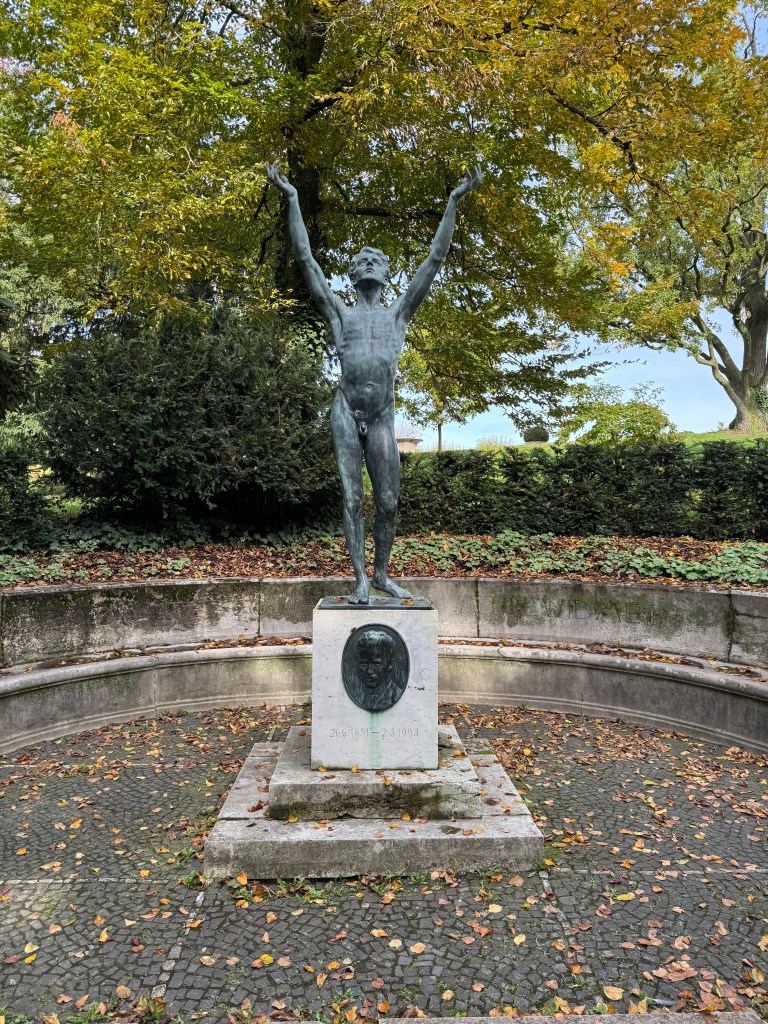


Nonetheless, I remember way back in 2021, Germany added another UNESCO World Heritage Site to its list: Mathildenhöhe Darmstadt. I Googled it and found out it’s approximately 35 km away from the city center, or like traveling from the toll exit of Balintawak to the Marquee Mall in Angeles City. In other words, my colleagues and I went there via Uber, which was more comfortable and cheaper than the train.
And yes, the community members in Darmstadt call it an artists’ colony. Our first impression was amazement. The main complex, composed of the Wedding Hall, the Exhibition Hall, and the Russian Church, was elegant and photogenic from every angle. These buildings are just the icing on the cake, so to speak. The WHS complex combines modernist buildings, cute little houses, gardens with exquisite Art Nouveau sculptures, and tree groves. The complex was laid out as the garden of the grand ducal court as early as the 19th century and was one of the most important centers of modern art and architecture in Europe and the world for 14 years, from 1901 to 1914. Its inclusion in the UNESCO World Heritage Site in 2021 underscores its global importance as a pioneer of modernity.
The artists’ colony was founded in 1899 by Ernest Ludwig, Grand Duke of Hesse. Once, he said to his fellow Hessen, “Mein Hessenland blühe und in ihm die Kunst” (“My Hessian land shall flourish and in it, the art”), and he expected the combination of art and trade to provide economic impulses for his land. To fulfill this dream of “flourishing art in the land,” Ludwig brought together several German Art Nouveau-ists in Darmstadt: Peter Behrens, Paul Bürck, Rudolf Bosselt, Hans Christiansen, Ludwig Habich, Patriz Huber, and his most entrusted friend Joseph Maria Olbrich. The artists aimed to develop modern and forward-looking forms of construction and living.


The oldest structure in the colony was the Duke’s house, built as a common atelier following plans drawn up by Olbrich. Olbrich worked as an architect and was the central figure in the group of artists. Peter Behrens was involved at first only as a painter and an illustrator. The laying of the foundation stone took place on 24 March 1900. The atelier was a worksite and a venue for gatherings in the artists’ colony. In the middle of the main floor is the meeting room with paintings by Paul Bürck, with three artist studios on each side. The entrance is located in a niche decorated with gold-plated flower motifs. Two six-meter tall statues, “Man and Woman” or “Beauty and Strength,” stand tall at the entrance and are Ludwig Habich’s work.
Since then, Ernest Ludwig has curated an art exhibition in the city. Four exhibitions were held under his helm in 1901, 1904, and 1908, and the last in 1914. The 1908 Darmstadt exhibition paved the way for the construction of the marvelous Exhibition Hall and the Wedding Tower, which still stand mighty and proud today.


By 1914, this group of artists specializing in jugendstil (the German counterpart of the art nouveau) ceased to produce more work for various reasons, the most significant of which was the beginning of the World Wars. The artists’ colony in Mathildenhöhe may only have lasted for a small period of time (late 19th century to 1914), it managed to become a safe space for new and revolutionary artists, paving the way to establish Darmstadt as a center for the German jugenstill. To this day, the creative spirit of the place is still alive. Residents continuously reinvent it through the reinterpretation and appropriation of this modernist art in the present. A good example is the Vortex Garden, which entangles art nouveau and contemporary new age philosophy.
 Tanghal Kultura