I mentioned elsewhere that my idea of Mumbai was the Juhu slums as depicted in the Hollywood blockbuster Slumdog Millionaire. As I also wrote previously, this perception was demystified when I got a chance to see the city myself and hinted that Mumbai’s charm is peculiarly beautiful because of its furiously chaos-in-order aesthetic. What I have not mentioned, and I think worth talking about is that Mumbai is also home to magnificent hidden temples, which adds to the city’s charm as an excellent example of a fantasy locale in a very good sense.
I managed to explore one of these hidden gems in November 2018. I am referring to the collection of sacred caves found on this island called Elephanta, somewhere in the middle of the Arabian Sea, some 10 kilometers away from the Gate of Mumbai, another beautiful architectural-monument that has also drawn many tourists and even pilgrims (did I not mention, hidden temples?) to the city.


The Mumbai Harbour through the Gate of Mumbai is the only and nearest entry point going to Elephanta Island. In this sense, the harbour and its surrounding nearby is a site to behold en route the island. I am lucky that I arrived at the port an hour earlier than the departure of the ferry going to the island, hence, I got the opportunity to take some pictures/photographs of some beautiful art deco buildings surrounding the area and to talk to some people.
From the harbour, the ferry took us about 45 minutes to the island and then we proceeded with a little walk from the deck to a train station that peculiarly looked like a giant toy-train. A joyful train ride brought us to the entrance of the caves which was preceded by a staircase leading to the main entrance of the temple-caves. Along the way are unique bazaars – souvenir shops, coffee shops, art stores, etcetera. After about a 30-minute climb, the UNESCO World Heritage marker is proudly waiting for us.

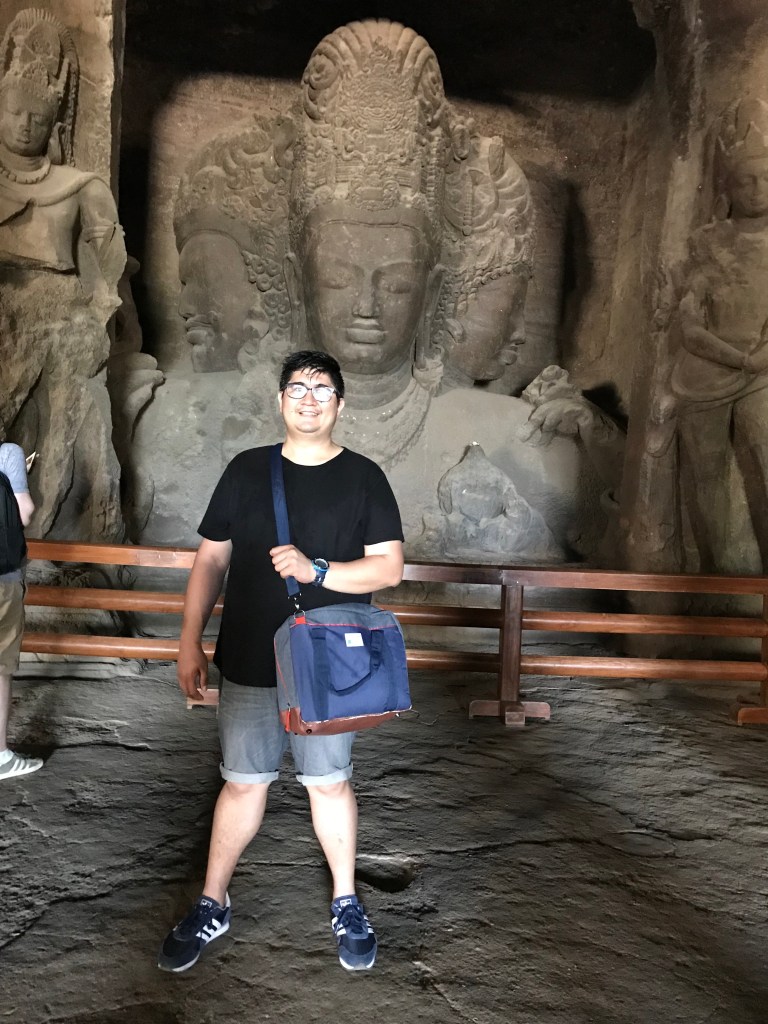


As I entered the first cave, I thought the tiring climb was worth-it. Just imagine, the carvings on the cave were magnificent. Apparently, the first cave is the most important among the caves as noted in the brochure provided by the ticket person. The cave measures 39 meters from the front entrance to the back. The main body of the cave, excluding the porticos on the three open sides and the back aisle, is 27 square meters and is supported by rows of six columns each. The centerpiece of the cave is Sadashiva, representing the three aspects of Shiva: the Creator, the Preserver, and the Destroyer. Other figures in the cave are Nataraja, Yogishvara, Andhakasuravadha, Ardhanarishwara, Kalyanasundaramurti, Gangadharamurti, and Ravanaanugrahamurtiare.
Open to the public are four more caves. According to the general information gathered from the Internet, the second cave, a little south-east of the first cave, appeared to me as something “unfinished.” However, I was told that its appearance is due to its complete destruction in the 1970s. There were attempts to reconstruct but the lack of blueprints are constantly shared as the reason for not being able to complete the reconstruction.
The third cave is next to the second one, as one continues to go away from the grand cave that is the first cave. Like the first cave, it is a portico with six pillars, and a mandapa with pillars. At the back of the portico are three chambers. The central door at the back of the portico leads to a damaged shrine, the sanctum seems to be for a Linga, but that is lost. The shrine door has some traces of sculpture. The dvarapalas on each side, leaning on dwarfs with flying figures over the head, are now in ruins. There are two other chambers, one on each side of the shrine but it was forbidden to enter that deep for reasons of safety and security.


The fourth and fifth caves are damaged. Some carvings are found in the fourth cave, while no artistic renderings are found in the fifth cave.
A little walk to the opposite side of the island is still unaccessible to commoners. I was told some archaeological activities were still ongoing. According to the internet, there are two more caves somewhere in the prohibited area and soon, these caves will be open to the public.
The Sixth Cave is called the Sitabai’s Temple cave, which is composed of a portico of four pillars and two pilasters. Although inaccessible to the general public, the temple cave is used, I was told, as a prayer hall of Buddhist monks and priests. The cave has three chambers. The central one is a shrine and the rest for monks or priests. There are no elaborate decorations similar to the renderings found in the other caves. However, the door of the central shrine has pilasters and a frieze, with the threshold decorated with lion figures. A local stated that this cave is historically significant because it was converted and used as a Christian church by the Portuguese in the later years when the island was a part of their colony.
The entire property was inscribed as a UNESCO World Heritage Site in 1987 for two reasons. First, the collection of caves represent a masterpiece of human creative genius. As stipulated in the UNESCO website, the fifteen large reliefs surrounding the temple in the main Elephanta Cave not only constitute one of the greatest examples of Indian art but also one of the most important collections for the cult of Shiva. Second, Elephanta Caves Complex bears a unique or at least exceptional testimony to a cultural tradition or to a civilization which is living or which has disappeared. UNESCO World Heritage Convention tells us that the caves are the most magnificent achievement in the history of rock-architecture in western India. The Trimurti and other colossal sculptures with their aesthetic setting are examples of unique artistic creation.
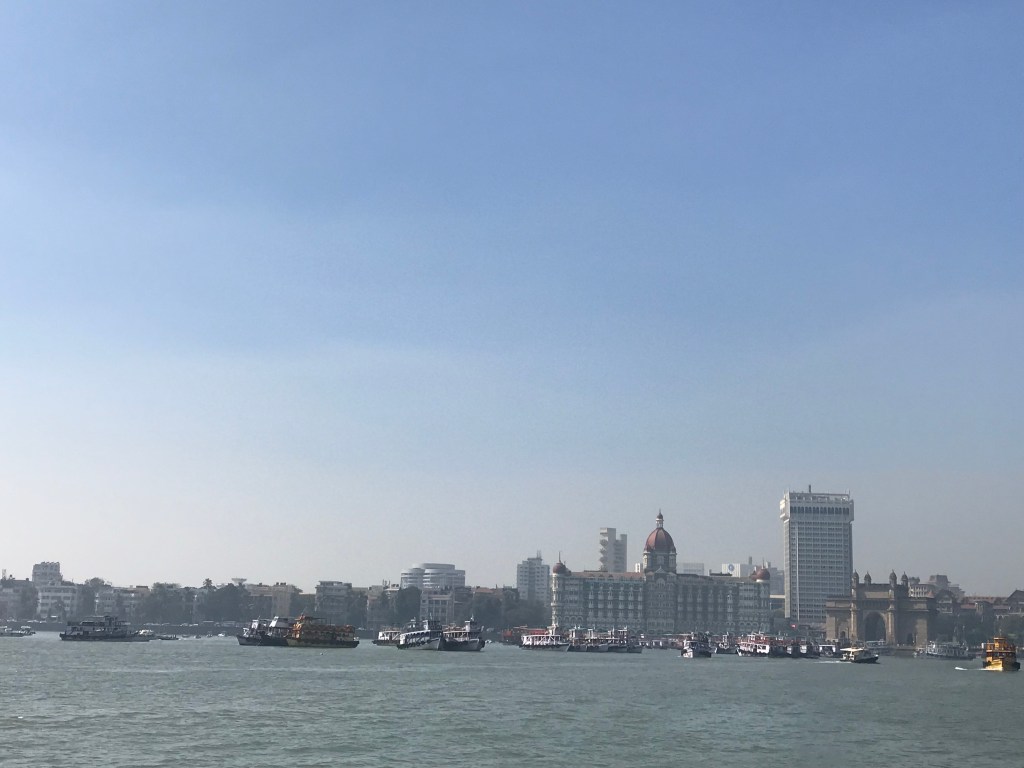

As I return to the mainland Mumbai, I got to see the beautiful city from the sea. The human spirit is always creative methinks.
However, while traveling in the waters, I thought the caves were marvelously created by the ingenuity and the needs of the human spirit to survive. The power of religion has the ability to motivate the human person to transcend themselves, to a point of transforming themselves into super-humans. How super-humans? These caves were constructed sometime between 450 and 750 AD. The carvings on the walls are so elaborate and so polished. A modern human cannot even construct such magnificent artworks without the aide of high-functioning technology. Considering our technology in this day and age is considered sophisticated, these artistic renderings are found difficult to construct in today’s time. During those times, one could just imagine that hand held tools as the most sophisticated technology used to carve these sculptures, columns, and reliefs.
 Tanghal Kultura