My expectations about traveling to Ghana were a combination of fear and excitement.
I was afraid because of the current socio-political standpoint of the nation’s legal framework against homosexuality which is found in the 2021 Promotion of Appropriate Sexual Rights and Family Values Bill of the country. The bill is set to criminalize the promotion, advocacy, funding and acts of homosexuality. It stiffens prison terms up to ten years for LGBTQi+ advocates and three years for anyone identifying as such. Moreover, the bill seeks to withdraw health services from this community, including HIV medication. In fact, the proponents of the bill Sam George, who is active in supporting his anti-LGBTQi+ sentiment on social media and calls himself as the son of God, does not believe homosexuality as a human right. As a queer individual myself, of course this is terrifying.
On the other hand, there was excitement. The opportunity to enter an African nation does not easily come very often. As an obsessed and self-proclaimed world heritage sites explorer, I wanted to put Ghanan monuments in my list of visited World Heritage Sites. Currently, there are two properties from this West African nation: the Asanti Traditional Buildings and the Forts and Castles facing the Atlantic Ocean.
On 22 June 2023, my passport was finally stamped by the immigration officer at the Kotaka International Airport (ACC), the gateway to this tiny nation in West Africa. The visit to Ghana was technically an official one – to attend the IFTR Accra 2023 because Manila through my Department at the University of the Philippines Diliman is hosting next year’s conference. As a tradition of the federation, the next host is presenting the conference plans during the closing ceremony of the current one: the University of Ghana.


Of course, part of any IFTR or any international conference for that matter is sight-seeing. A lot of conference hosts include excursions, both paid and free, in their social programs. As for me, the sight-seeing is to explore cultural locations, especially world heritage sites nearby. Kyoto monuments and monuments in Hiroshima were explored when Osaka University hosted IFTR in 2011. I visited several buildings designed by Gaudi on the occasion of IFTR 2013 in Barcelona. I went to the Skogskyrkogården and Drottingholm Palace in Sweden in 2016. I have seen Brasilia and the Carioca Landscape in Rio when Sao Paolo hosted IFTR in 2017. I saw the Felix Romuliana (IFTR Belgrade 2018), the Chinese Gardens (IFTR Shanghai 2019), and the Þingvellir National Park (IFTR Reykjavik 2022).
In my almost ten days in Ghana, I also spent a few days exploring Accra and nearby towns. Specifically, I went to see Ghana’s National Theatre, the Arts Centre, and some forts and castles. Some are UNESCO World Heritage Sites, collectively called Forts and Castles, Volta, Greater Accra, Central and Western Regions – four are located in Accra while several are in nearby regions of Western Ghana, Central Ghana and Volta.
The conference’s opening ceremony was scheduled in the afternoon of 24 July (Monday). My colleagues and I decided to see the city centre. Since we are from the theatre, it was just apt that we start with the National Theatre.


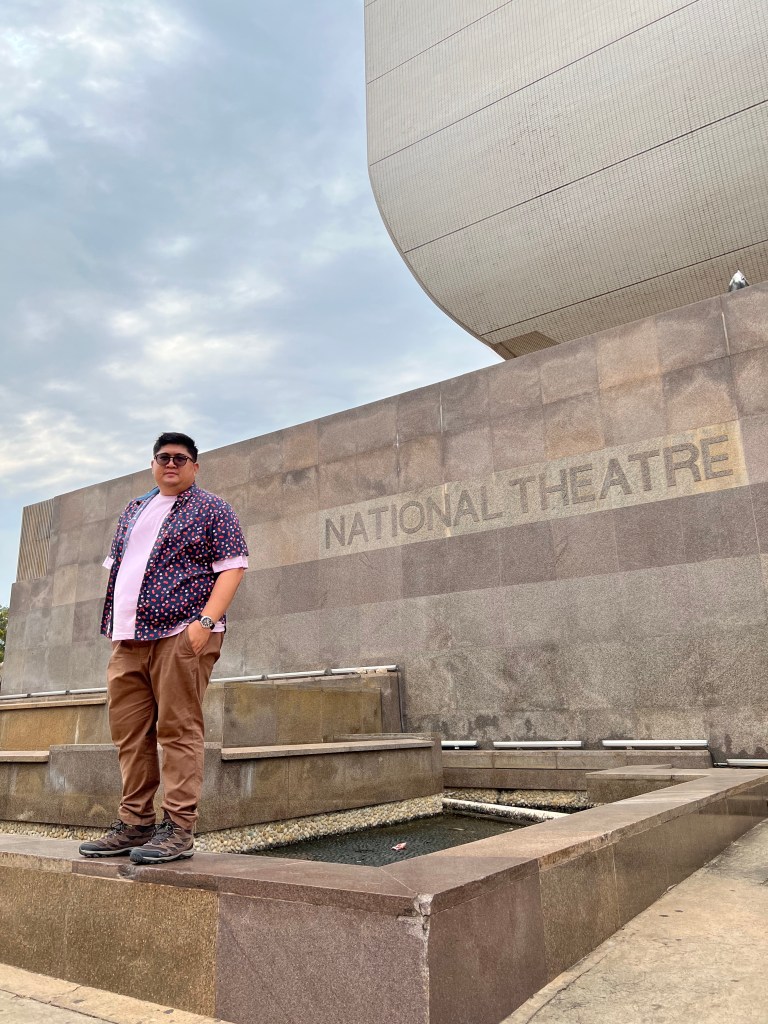
According to the internet, the National Theatre was opened in 1992. It was explained by our colleague from the University of Ghana that a National Theatre Movement (NTM) was conceived around the time of Ghana’s independence in 1957 to help remold the new nation’s cultural identity. But it was only in the 1990s that the idea of a theatre (a structure) was formalized in the congress. In 1991, the National Theatre Law was born via the National Theatre Law 259. Today, the theatre houses three companies: the National Dance Company, the National Symphony Orchestra of Ghana, and the National Theatre Players – all of which are in partnership with the University of Ghana, the host of the 2023 IFTR Annual Conference.
Nonetheless, my favorite part of this sight-seeing was Jamestown and Usshertown, the oldest districts of Accra. According to Emmanuel, our tour guide slash driver, these towns were the origin of the Accranian people, the fishing people called Ga. Once upon a time, Accra was known as A-ga-ra.
These districts in the Greater Accra Region possess certain charm that I thought comparable with Melaka, Georgetown, and Ipoh in Malaysia; and Little India in Singapore. Just like these Southeast Asian cities, Jamestown and Usshertown were once upon a time British colonies. And all of them are strategically located along the coast of the cities – for trade. Today these cities are vibrant and lively. However, Jamestown and Usshertown possess some stories that continue to haunt the history of humankind: 400 years of inhuman conditions brought upon by the European imperial rules onto the entire continent of Africa.
My knowledge about the Trans-Atlantic Slave Trade is mostly based on popular culture, Hollywood films in particular. Visiting the forts at Jamestown and Usshertown and listening to the stories of Ussher Fort from the perspective of the people whose forefathers either survived, tortured, or killed by the colonizers were tremendous as much as they were also eye-opening.
Jamestown Fort was not open for tourists at the time of our visit but its imposing structure is really terrifying. Emmanuel told us that the infamous lighthouse was used by the Dutch and the British to properly dock their ships which took Africans en route the Americas (then the New World) via Europe. As the Ghanians say, “for every entrance to the ship, there is no exit.” The Africans were marked using a hot rod – piercing and burning their skins, and were sold to Europeans in the New World as slaves.


We were able to enter Ussher Fort. We were welcomed by our female guide who even though her descriptions of the place are too “marked” – her non-scripted remarks were more intense and more horrifying. For instance recalling her grandmother story about her grandmother’s grandmother’s mother who was once captured and was brought to the fort for the slave trade. She was one of the few who never stepped into the shores of the Atlantic Ocean because her frail body did not survive the tenacious demand of being a “resident” of the fort. This is the main reason why our guide was motivated to volunteer at the Fort. In my view, I thought she felt the need to continue the story of her great great great grandmother because as she commented: the history of slavery continues to affect our present. In fact, this history haunts the present: racism and the construction of “other” are still dominant everywhere.
What also struck me – these people behind the human trade were very religious people. They were Christians. In fact, our guide told us that the Dutch and the British back then were backed up by the Christian Church. It was common that friars were also residing with the top leaders of the colonizers in the forts and in the castles, which I will talk about later on. Our guide informed us that the priests were there to “pray for the souls of those who died.” In my mind, this dark period of the Christian Church is also very much in effect in the present. I am reminded how the Christian Church, whose mission is to teach the congregations about kindness, love, and compassion, is also the very reason why there is also an ambient fear against the LGBTQi + people all over the world.


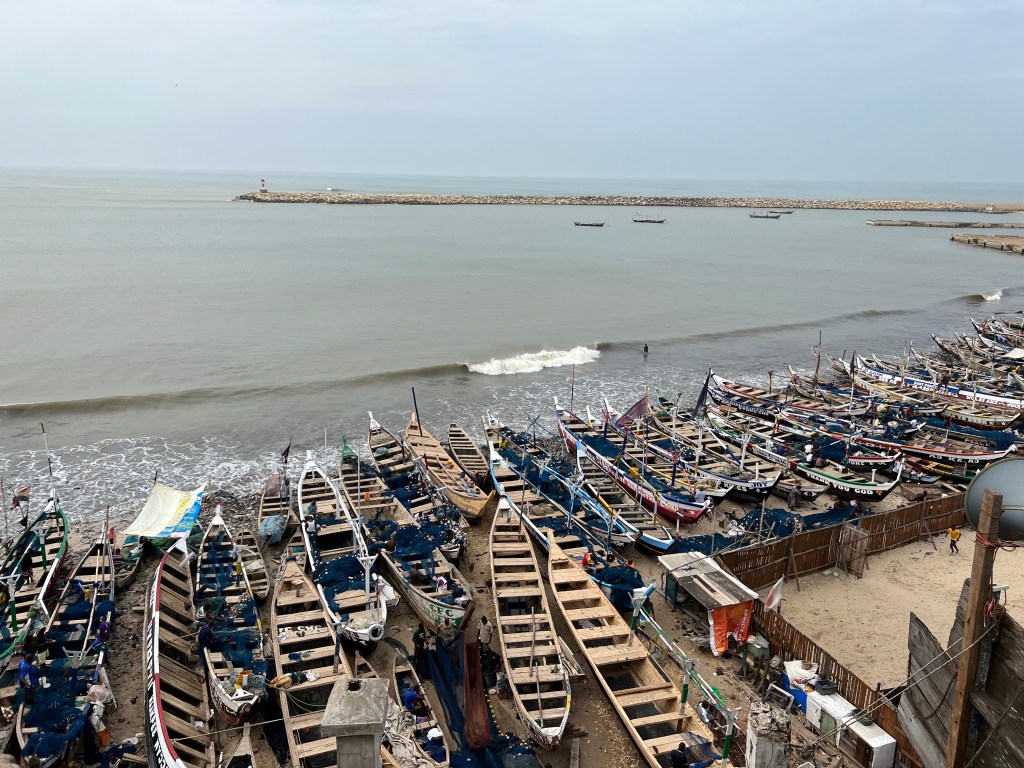
Another unforgettable story that we learned from our guide is the desecration of the bodies of those who died in the forts. The guide brought us to what is believed to be a condemnation room. In the middle of the room is a rectangular pit – about 4 feet deep, 4 feet wide and about 10 feet long. On one end of this rectangular pit is a chamber, which according to our guide was leading to the ocean. Dead bodies are dropped to the pit and they are flushed out of the room via the chamber and are thrown to the Atlantic Ocean.
When we were looking across the waters – I cannot help but think of the dead, and the thousands of bodies thrown into the ocean. Flowers are everywhere. They were offered by high school students who also remember the story as a significant history that must not be forgotten.
The breeze was terrific. I had goosebumps. I closed my eyes – prayed.
One question in my head: have we really learned from this dark history of mankind?
 Tanghal Kultura
One Comment Add yours